How to Stop Losing Leads You Already Earned
Find where your enquiries go missing, what it costs you, and fix the biggest leak this week.
For Australian businesses that suspect enquiries are slipping through the cracks
You've already paid to be found, through your website, your ads or a referral you earned, so it stings when an enquiry slips away: the call nobody returned, the quote nobody chased, the happy client who never heard from you again. Nobody decides to lose them, and no report shows them, so the cost stays hidden.
This guide is a one-week test of your lead follow-up. You'll contact your own business the way a customer would, count what slipped through last month, put a number on it, and fix the biggest leak first, using what you already have: an inbox, a spreadsheet or a CRM. You don't need to buy anything to run it.
In short
To stop losing leads, send a test enquiry through every way customers reach you and time the reply. Then list last month's enquiries, plus the quotes and past clients that went quiet, and work out what they're worth. Fix the biggest leak first with what you already have, and spend 15 minutes a week keeping it fixed.
Before you start
- Time: about three hours, spread over a week, because some tests mean waiting for a reply.
- Who: you, or your practice or operations manager.
- What you need: last month's enquiries, your quotes from the last 90 days, your client list, and a phone number and email address your team won't recognise.
- What you'll end up with: your real reply times, what slipped and what it's worth, your first fix running, and a weekly check in the diary.
- Checked: the rules and sources in this guide, November 2026.
Only have 15 minutes?
Start here. Tonight, ask a friend to fill in your website form and call your main number after hours. Tomorrow, see what they got back. Then count the quotes from the last 90 days that ended with no decision. If either answer surprises you, the full test is worth your week.
Three words, plainly
A lead is an enquiry from someone who might become a client. A quote is anything you send before someone says yes: a quote, a proposal, a fee estimate or a treatment plan. A CRM (customer relationship management software) keeps every client, enquiry and follow-up in one place, and reminds you what's next.
Where do leads go missing?
In three places, and they share one cause: in a busy week, follow-up depends on someone remembering.
Our book on follow-up, Built to Close, calls these the three leaks. Its first chapter, Why your business needs a memory, explains why growing businesses have them.
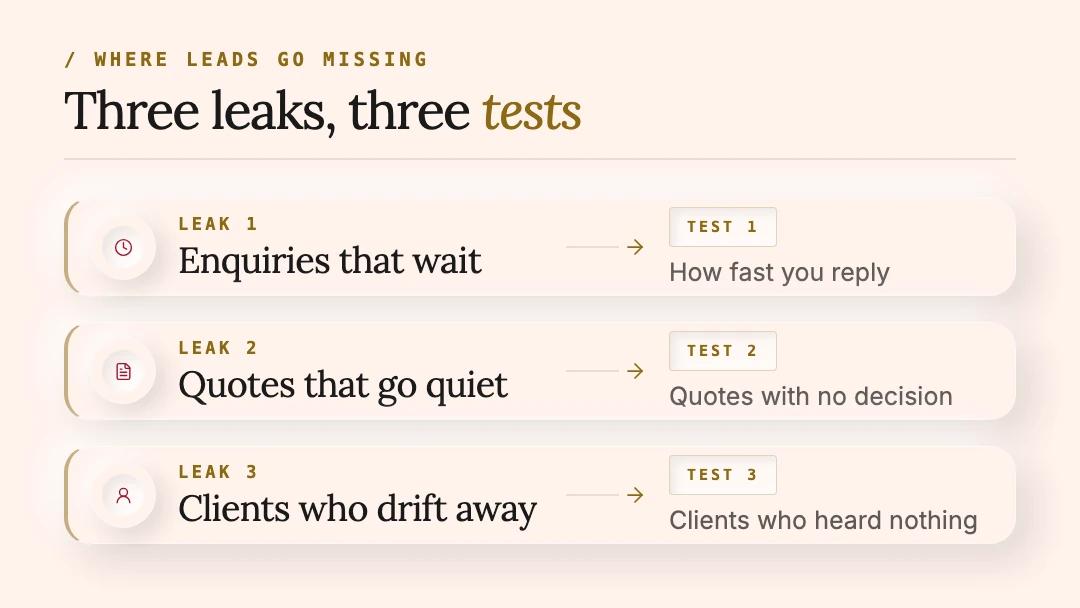
Each leak has its own test. Start with the one that worries you most.
The three tests below show how big each leak is in your business.
Test 1: How fast do you really reply?
You only see the enquiries that reached you, so the only way to know your real reply time is to try it yourself: contact your business the way a customer would, then count last month's enquiries.
Step 1: Try it as a customer
An automatic reply is a good start, but it only counts if it tells them when a person will be in touch. And a quick reply that doesn't answer their question still leaves them waiting. Remember, you're testing the setup, not your people. Let the team know a test is coming this month, without saying when, and if the after-hours call goes nowhere, treat it as a gap to fix, not someone's fault.
To copy: the test sheet
One row for each way in, with six columns: way in; when you sent it (day and time); first real reply (day and time); who replied (a person, or an automatic reply); did it answer the question? (yes, partly or no); did it say what happens next? (yes or no).
Or download the lead leak worksheet (Excel): it has this test sheet and a tab for each later step, from the lead list to the weekly check, and it does the counting and the sums for you.

An example test: the automatic reply came within a minute, but a person replied 13 and a half hours later.
Step 2: Count last month
If calls or messages aren't recorded anywhere, count what you can find and note the gap. An enquiry nobody can find is a leak too.
To copy: the lead list
One row per enquiry, with eight columns: when it came in; how it came in; who; what they asked for; who's handling it; first real reply; where it's up to (new, contacted, quoted, won, lost or no decision); next step and its date. "Contacted" means someone spoke to them or sent a reply that answers their question, not that someone meant to call.

Whichever way an enquiry comes in, it lands in the same list, with someone handling it. Example rows.
Only add a column if someone will act differently because of it, and put everything else in a note. Keep the list going, and in a few months the "how it came in" column will also show you which marketing brings in enquiries.
To copy, if you use an AI assistant: a prompt to build the list faster
Below are the enquiries my business received last month, with names and contact details removed. Make a table with one row per enquiry: when it came in, how it came in, what they asked for (in a few words), and when we first replied, if that's shown. Leave a cell blank rather than guess. Then count how many came in through each way in, and how many show no reply. [Paste the enquiries here]
Before you paste, take out names, phone numbers, email addresses and anything about someone's health. The privacy regulator, the OAIC, recommends that organisations "do not enter personal information, and particularly sensitive information" into publicly available AI tools.
How fast is fast enough?
Pick a standard you can keep, then test against it. A good starting point is an automatic reply within a minute that says when a person will be in touch, a real reply within the hour during opening hours, and by 10 am for anything that comes in overnight. These are example times, so choose ones you can keep on your busiest day.
Why example times? The best research we found is a 2011 study for Harvard Business Review, which found most US companies "are not responding nearly fast enough". It's old, and one of its authors ran InsideSales.com, a sales software company. Newer figures mostly come from companies that sell reply software.
The other view. A referral already trusts you, so tomorrow may be fine, and someone weighing up a big decision, like a new home or a course of treatment, may value a careful answer over a quick one. Even then, an automatic reply that says when they'll hear from you costs nothing.
Test 2: Which quotes went quiet?
When a quote goes quiet, it's easy to assume they weren't interested. Often they just haven't decided. This test counts your quiet quotes, and gives you a plan and three messages for the next ones. If you rarely send quotes or treatment plans, skip to Test 3.
The test
Why quotes go quiet
A quiet quote isn't always a no. The authors of The JOLT Effect, a 2022 book based on more than two and a half million sales conversations, found that many buyers who stall are afraid of making the wrong choice, and that easing that fear is what gets them to go ahead. Their study covered sales calls across many industries, not just businesses like yours, so take it as a pointer. It's why each message below gives them something useful, instead of just asking for a decision.
A follow-up plan for every quote
Follow up sooner at the start, while your quote is fresh in their mind, and leave longer gaps later. This timing is a rule of thumb, not a research finding, so adjust it to your work:
- Day 0: send the quote, and say when you'll be in touch.
- Day 2: check it arrived, and offer to take them through it.
- Day 7: answer the question people usually have at this point.
- Day 14: call, with a real reason, such as a start date or the date the quote expires.
- Day 21 to 30: send the polite close.

Closer together at the start, further apart later. Example timing: adjust it for your work.
Give every quote an expiry date, such as 30 days. It's fair to the client, and it gives you a natural reason to get back in touch.
To copy: did it arrive? (day 2)
Hi [name], it's [your name] from [business]. I sent your [quote] for [the work] on [day]. Would a 10-minute call help? I can take you through [the part people ask about most, such as the timing or what's included]. Does [day and time] suit you?
To copy: the useful nudge (day 7)
Hi [name], a question that often comes up with [the work] is [the likeliest doubt]. The short answer: [one or two lines]. If anything else in the [quote] isn't clear, reply here and I'll answer it. If you'd rather I didn't follow up, just say so.
To copy: the polite close (day 21 to 30)
Hi [name], I haven't heard back, so I'll take it the timing isn't right and stop following up. If anything changes, reply here or call me on [number], and we'll pick it up from there. Thanks for considering us.
When does following up become pestering?
When a message asks for something and gives nothing back.
Asks, gives nothing
Just checking in on the quote. Any thoughts?
Gives before it asks
A question that often comes up is how the payments are staged. Here's how it would work for yours.
Make every follow-up useful: an answer, a helpful detail or a real deadline. Stop after the polite close, and never follow up someone who has said no or asked you to stop. Chapter 7 of Built to Close, Following up without burning people, goes deeper.
Test 3: Which past clients went quiet?
Past clients already know and trust your work, which makes them some of your best leads, and the easiest to forget. This test shows how many haven't heard from you since the work finished.
Keeping a client costs far less than finding one: depending on the study and the industry, winning a new customer costs five to 25 times more than keeping an existing one, according to Harvard Business Review.
The test
To copy: the check-in
Hi [name], it's [your name] from [business]. It's been about [six months] since [we finished the work / your last visit], and we wanted to check how things are going. If anything needs a look, reply here and we'll help.
To copy: the review or referral request
Hi [name], thanks again for choosing [business]. If you were happy with [the work], a short review would help other people find us: [link]. And if someone you know ever needs [what you do], we'd be glad to help. Reply STOP if you'd rather not hear from us.
As a rule of thumb, we'd get in touch with a past client once or twice a year, not monthly. Keep the check-in about them, with no offer in it, and for a health practice, leave out the treatment and the reason for the visit.
A review or referral request promotes your business, so treat it as marketing: ACMA's spam rules need consent, your business name and an easy way to unsubscribe. ACMA says consent can be inferred from an ongoing relationship when the message is directly related to it, but not just because someone once bought from you. The simplest way to be sure is a tick box on your booking or intake form. Health practices have extra rules on reviews, which our post on automating Google review requests covers.
What are the leaks costing you?
Multiply what slipped by how often it usually turns into work, and by what that work is usually worth. It's not money you've definitely lost, because some of those people would never have gone ahead, but it shows you what's at stake.
- Enquiries: enquiries with no reply last month × how many in 10 usually become clients × what a new client is usually worth = what slow replies cost you a month.
- Quotes: quotes with no decision × how many in 10 you usually win × the average quote = what's sitting in quotes nobody chased.
Example, with made-up numbers
Last month, 10 enquiries got no reply. Usually 3 in 10 enquiries become clients, and a new client is worth about $2,000. That's 10 × 0.3 × $2,000 = $6,000 of work a month. On top of that, 8 quotes ended with no decision. You usually win 4 in 10, and the average quote is $5,000, so 8 × 0.4 × $5,000 = $16,000 is sitting in quotes nobody chased.
Your win rate is the quotes you won divided by the quotes you sent. If you don't know your numbers yet, a careful guess is fine for now: the point is to compare the leaks, not to be exact. Past clients don't fit a formula as neatly, so just count them. The number who haven't heard from you is the size of that leak.

The same sums as the example, with made-up numbers. Put yours in the worksheet.
If the numbers are small, fix them with what you already have. If they're big, you now know what fixing them is worth before you spend a cent.
How do you fix the biggest leak?
Start with the leak that costs the most, and fix just that one this week. Many fixes need a setting and a habit, not new software.
If replies are slow or missing
- An automatic reply on your form and enquiries email, saying who you are and when they'll hear back.
- One person responsible for each way in, with a backup, so every enquiry is somebody's job. Our post on how to stop missing leads when you're busy shows how to set it up.
- A text back for missed calls, plus a reminder to call back. Our post on the missed call your business can't afford to ignore shows the options.
- After hours, an away message with a time, and whoever's responsible works through the list first thing.
- If they don't answer your reply, try again the next day, again on day 3 with something useful, and one last time on day 7, before you mark it no decision.
To copy: the automatic reply
Thanks for getting in touch with [business]. [Name] will call you by [time] today. If it's urgent, call us on [number].
To copy: the missed-call text
Hi, this is [your name] from [business]. Sorry we missed your call. How can we help? Reply here, or we'll ring you back by [time].

An example: the missed call gets a text straight away, and a person rings back by the time it promises.
If quotes or past clients go quiet
For quotes, put the follow-up dates in your calendar or CRM the day each quote goes out, give it an expiry date, and reuse the three messages from Test 2 in your own words. For past clients, set a reminder for six months after the work finishes or after their last visit, and ask for consent to send news and review requests when the work starts.
Do you need a CRM yet?
Not to run this test, and maybe not for your first fix. As a rough guide, a shared spreadsheet with one row per enquiry works while one or two people handle a handful of enquiries a week. A CRM earns its place when several people handle enquiries, when enquiries come in through several ways in and you're tired of retyping them, when follow-ups should happen without anyone having to remember, or when you want to know which marketing brings in work.
When you get there, choose the smallest system you won't outgrow in the next two years. General CRMs such as HubSpot, Pipedrive and Zoho all handle the basics, and some practice and project management software tracks enquiries too, so check what you already pay for. Our post on how to replace your spreadsheets with a CRM that actually works covers the move.
How do you keep it fixed?
Leaks come back when nobody's looking. Fifteen minutes a week and one test enquiry a month keep them closed, so nobody has to carry follow-up around in their head.
The 15-minute weekly check
- Did every enquiry this week get a reply within your times?
- Which enquiries and quotes have no next step and date? Give each one now.
- Which quotes are due a follow-up, or past their expiry? Follow up or close them.
- Which past clients are due a check-in?
Once a month, send a test enquiry through each way in that has an automatic reply, and check it still arrives. Forms and automations can stop working without telling anyone. And keep the lead list going after the test week, so next month's count takes minutes, not hours.
Questions owners ask
Quick answers to common questions, the Australian rules in brief, and where to go next.
How fast should we reply to an enquiry?
Straight away with an automatic reply that says when a person will be in touch, then a real answer within the hour during opening hours, or by 10 am for overnight enquiries. Pick times you can keep on your busiest day, and check them with a test enquiry each month.
How many times should we follow up a quote?
About four times over three to four weeks, each time with something useful, then a polite close. Stop as soon as they say no or ask you to stop.
Do we need a CRM to track leads?
Not to start. A shared spreadsheet is enough while one or two people handle a handful of enquiries a week. Once several people, several ways in or automatic follow-ups are involved, it's time to look at one.
Can we follow up by email or text in Australia?
Yes. A message that only answers someone's enquiry, and says who you are, is a reply to them, and following up a quote they asked for continues that conversation, as long as you name your business and stop when they ask. Offers, news and review requests are marketing, so ACMA's spam rules need consent, your business name and contact details, and an easy way to unsubscribe.
The rules in Australia, in brief
- Messages: the Spam Act 2003 applies to every business. Marketing emails and texts need consent, your business name and contact details, and an easy way to unsubscribe that you act on within five working days. ACMA's guide explains when consent can be inferred.
- What you keep: the Privacy Act 1988 covers every health practice, whatever its size, and other businesses once their turnover passes $3 million a year, plus a few smaller ones. The OAIC's checklist shows whether yours is covered. Either way, keep only what the lead list needs, and keep client details out of public AI tools.
This is general information, not legal advice.
Where to go next
Built to Close, our book on follow-up, explains the why behind each part of this guide:
- the three leaks: Why your business needs a memory (chapter 1);
- when a CRM is worth it: What a CRM actually is, and what you own (chapter 2);
- following up without pestering: Following up without burning people (chapter 7);
- which marketing brings in work: Lead tracking (chapter 8).
Setting all of this up so it runs without anyone having to remember is what our CRM & Lead Tracking service does.
Sources
Checked in November 2026.
Want a hand with the fix?
Book a call and bring what you found, even if it's only the 15-minute version. We'll go through it with you and tell you honestly which leak to fix first, what it would take, and whether you need us for it.
BOOK A CALLNo upselling and no hidden costs. If it isn't worth doing, we'll say so.