Why is your business growing but you have no cash? Growth ties up cash in unpaid invoices, wages and tax. A worked example, and what to fix first.
IN THIS ARTICLE
Your 14-person agency has just had its best year: three new retainer clients, two new hires and sales up by a third. Then payroll week comes around, and the bank balance is the lowest it's been all year.
If you're asking why your business is growing but you have no cash, the answer is usually timing, not profit. Here's how growth ties up cash, how much it ties up, and what to fix first, with an example you can run on your own numbers.
The short answer
A growing business runs short of cash because it pays for growth before clients pay for the work. Wages, super, tax and software leave on fixed dates, while invoices are paid weeks later. The faster you grow, the more cash waits in unpaid invoices. Get paid sooner, set tax aside and look 13 weeks ahead.
Why a growing business runs out of cash
Profit and cash measure different things. Your profit and loss report counts a sale on the day you invoice it, but the cash arrives when the client pays. On 30-day terms that clients stretch to 45, an invoice sent on 31 March is paid around 15 May, and in those six weeks you've paid your team three times. So when sales grow, the costs grow first and the money follows weeks behind.
A quick check tells you which problem you have. If your profit and loss report shows a profit but the bank balance keeps falling, it's timing, and this post is for you. If it shows a loss, the problem is profit, and faster invoices won't fix it.
You're not alone in this. In a survey of 507 Australian business owners and decision-makers, run by YouGov for CommBank and published in January 2025, nearly 80% said their cash flow had been affected in the past 12 months, and 27% had dipped into personal savings, skipped their own salary, or both.
Left alone, the gap can sink a profitable business. When a company fails, its administrator, usually a liquidator, reports the causes to ASIC. In 2024-25, 5,446 of 9,585 first reports, 57%, named "inadequate cash flow or high cash use", more than any other cause (ASIC's insolvency statistics, released December 2025). Administrators can name several causes in one report, so that's the share of reports listing cash flow among them, not the share of failures it caused on its own.
How much cash growth ties up
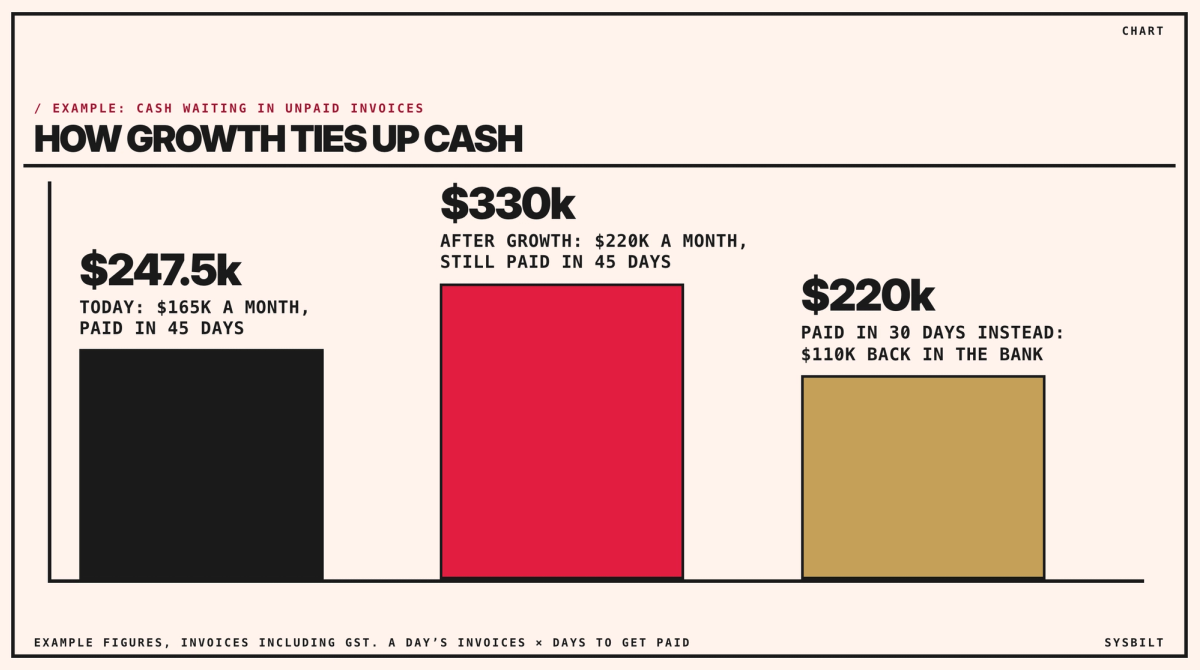
Here's an example for an agency like yours, on 30-day terms that clients pay in 45. The numbers are made up, but the sum works for any business that invoices and waits:
Cash waiting in unpaid invoices = what you invoice per day, including GST, × the days clients take to pay.
- Today: $150,000 a month in sales before GST is $165,000 a month in invoices, or about $5,500 a day. Paid in 45 days, about $247,500 is waiting in unpaid invoices.
- After a year of growth: $200,000 a month before GST is $220,000 in invoices, about $7,300 a day. Still paid in 45 days, about $330,000 is waiting, so $82,500 more of your cash is tied up, even though the business is more profitable.
- Paid in 30 days instead: at $220,000 a month in invoices, about $220,000 is waiting, which puts $110,000 back in the bank.
That $110,000 is a one-off release, not $110,000 every month, but if your 14 people earn around $90,000 each, it's about two fortnightly pay runs, super included.
To run it on your own numbers, open the aged receivables report in your accounting software: the list of who owes you, how much and for how long, GST included, because clients owe you the whole invoice. In Xero it's called Aged Receivables Summary, and MYOB and QuickBooks have their own versions. As a yardstick, businesses that invoice through Xero, with sales under $50 million, were paid 24.3 days after invoicing on average in the September 2026 quarter, and 6.9 days after the due date (Xero's figures). The agency in the example waits 45 days, about three weeks longer than that, which is why so much of its cash is tied up.
Where cash gets stuck, and the first fix
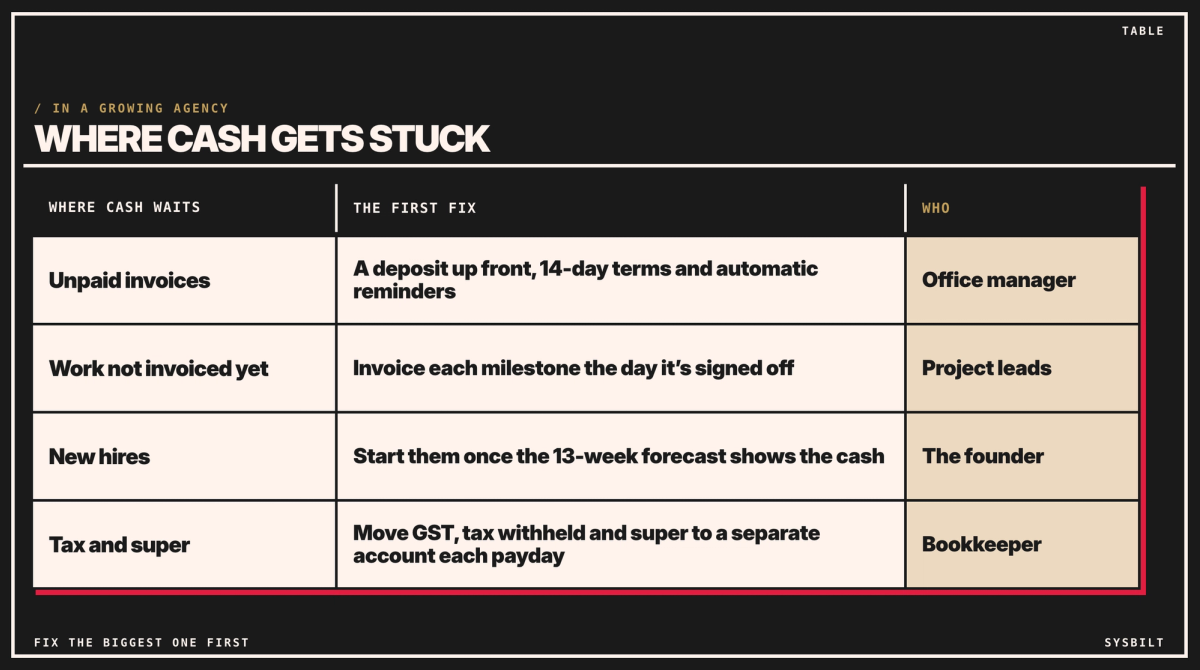
Four places hold most of a growing firm's cash. To find your biggest, compare your days to get paid with your terms, list the work that's finished but not invoiced, add up the wages you've taken on this year, and check how much of your bank balance is tax.
Unpaid invoices
This is cash stuck after the invoice. The longer clients take to pay, the more of your money they're holding: in the example, every 15 days you take off frees half a month's invoices. Ask for a deposit before project work starts, bill retainers at the start of the month, and offer new clients 14-day terms. For existing clients, change terms at the next renewal or project, and say so plainly, such as "From February, new projects start with a deposit and invoices are due in 14 days." Then put a pay-now link on every invoice and let the reminders go out on their own. Our post on automating overdue invoice emails shows how your office manager or bookkeeper can set them up.
Work you haven't invoiced yet
This is cash stuck before the invoice. If you invoice at the end of a project, or at the end of the month, the hours your team has already worked are cash you've spent and can't collect yet. Accountants call it work in progress. Ask your project leads to invoice each milestone on the day the client signs it off.
Hiring ahead of the work
A new hire costs wages and super from their first payday, while the invoices for their work are paid a month or two later. Two hires on $90,000 a year each cost $15,000 a month between them, plus $1,800 in super, before the first invoice for their work is paid. Before someone starts, check a 13-week forecast, a week-by-week list of the cash you expect in and out over the next three months, for the weeks their wages go out and the weeks their work is paid for.
Tax and super that aren't yours
Some of the money in your account belongs to the ATO or to your staff's super funds. If you used to pay super each quarter, that money could sit in your account for up to four months. Since 1 July 2026 it can't: super has to reach each employee's fund within 7 business days after payday, at 12% of their earnings (ATO). The GST on your invoices goes to the ATO with your BAS, usually each quarter. The tax you withhold from wages goes each month once it's more than $25,000 a year, which for a team your size it will be.
So move the GST, the tax withheld and the super into a separate account each payday, and pay the BAS and the super from there. If your turnover is under $10 million, also ask your accountant about GST on a cash basis, where you pay the GST on a sale once the client has paid.
Spending that money to cover a gap is how a cash squeeze turns into a tax debt. When administrators told ASIC in 2024-25 that a company had kept trading while it couldn't pay its debts, 84% listed unpaid tax, such as GST, tax withheld from wages or the super guarantee charge, as a warning sign (ASIC's insolvency statistics).
Start this week
- 01Work out your days to get paid. Open the aged receivables report and see how long, on average, your clients take to pay. If it's longer than your terms, start with the unpaid invoices.
- 02Bring in what's owed now. Call the clients with the three biggest overdue invoices, and send an invoice today for any finished work you haven't billed.
- 03Look 13 weeks ahead. A spreadsheet with a column for each week, the cash you expect in and the cash going out, shows your lowest week while there's still time to act. Our post on projecting cash flow 90 days out walks through it.
If that lowest week is below what you need, talk to your bank now, while the numbers look good, about an overdraft, a line of credit or invoice finance, where a lender advances most of an unpaid invoice for a fee. And if a BAS is due and the cash isn't there, lodge it on time anyway and ask the ATO about a payment plan. Interest still applies, so a shorter plan costs less.
What to check every Monday
Three numbers tell you whether you're safe this month:
- Cash in the bank today, not counting the account where you keep the tax.
- What clients owe you, and how much of it is overdue.
- What's due out in the next four weeks: wages, super, the BAS, rent and suppliers.
What good looks like: clients paying close to your terms, and a buffer. As a minimum, we'd suggest enough cash outside the tax account to cover your next pay run and the super that follows it. If a few large payments make up most of your income, hold more, as the 90-day forecast post linked above shows for a builder.
If what's due out is more than the cash in the bank plus what's likely to come in, you have a gap to close now, not at the end of the quarter.
If you'd rather not build this by hand, we set up dashboards that pull these numbers from your accounting software every day, so you see the gap before payroll week does. That's part of our Dashboards & Reporting service, which puts your cash, sales and overdue invoices on one screen.
If you'd like a second pair of eyes on your numbers, book a 15-minute call with our team in Sydney, by phone or video. Bring your aged receivables report and your known bills for the next three months, and we'll work out your cash gap with you, so you leave knowing the first two things to fix. There's no obligation after the call, and we don't upsell.

WRITTEN BY
Felipe Chaparro
Systems Architect and Founder of SYSBILT. Felipe engineers custom automation, AI workflows, and performance web architectures for scaling Australian service businesses.