Still running your business manually? Learn how to automate a business in Australia with a three-phase system that gives you your time back.
In this article
- //What Business Automation Actually Means for a Seven-Figure Business
- //Why Most Australian Businesses Are Still Doing Everything by Hand
- //The Three Stages of Business Automation (and Where You Fit)
- //What to Automate First (and What to Leave Alone)
- //The Numbers: What Automation Actually Costs and Returns
- //A 90-Day Roadmap: From Manual Chaos to Running System
- //The Mistakes That Waste Money (and How to Avoid Them)
- //Where Australian Businesses Go From Here
You built a business that works. Now it's eating your life. Every lead that slips through, every invoice you chase manually, every question your team waits on you to answer adds up to a business that can't grow without more of you. This guide shows you how to automate your business in Australia, step by step, using a system that connects everything instead of bolting on random software and hoping for the best.
What Business Automation Actually Means for a Seven-Figure Business
Business automation isn't about robots or code. It's about removing yourself from the tasks that repeat, so you can focus on the work that actually needs you.
For a business turning over $1M to $5M, automation looks like this: a lead comes in through your website at 9 PM and gets a reply within 60 seconds, without anyone touching it. An invoice goes out the moment a job is marked complete. A customer who hasn't come back in 90 days gets a check-in email that sounds like it came from your team, because it did, once, when someone wrote the template.
After that, the system handles it.
This isn't about replacing people. It's about freeing them. The admin assistant who spends three hours a day copying data between your CRM and your accounting software could spend that time on client relationships instead.
The office manager who manually generates weekly reports could focus on improving the processes those reports are tracking. Automation handles the repetitive layer so your people can do the thinking work.
The technology already exists. Businesses with fewer than 20 staff, the category COSBOA counts as small business, make up 97% of all Australian enterprises and contribute more than $589 billion to the national economy (COSBOA and Square, State of Small Business Report, 2025, checked October 2026). Yet most are still running critical processes by hand. The gap isn't the tools. It's knowing where to start and how the pieces connect.
Why Most Australian Businesses Are Still Doing Everything by Hand
The data tells a muddier story than most summaries admit. The National AI Centre's Responsible AI Index, run with Fifth Quadrant and published in December 2024, found 35% of Australian SMEs using AI (National AI Centre and Fifth Quadrant, December 2024, checked October 2026). Deloitte Access Economics, surveying more than 1,000 Australian small and medium businesses a year later, put it at two-thirds (Deloitte Access Economics, The AI edge for small business, commissioned by Amazon, 25 November 2025, checked October 2026). The two surveys measured different populations a year apart, so treat the gap as a range rather than a sudden jump. What both agree on is depth: Deloitte assessed just 5% of the businesses using AI as fully enabled against its maturity index, meaning the rest are working at the surface.
This is what it looks like in practice. A lead calls at 5:30 PM on a Friday and nobody picks up. By Monday, that lead has already booked with a competitor who had an automated booking system. An invoice sits in someone's to-do list for three days because they're busy with a bigger job, and the cash flow ripple hits you two weeks later.
"This productivity gap drags on Australia's broader economic performance. Artificial intelligence offers a powerful way for businesses to increase efficiency and drive economic growth, if they can clear the barriers that prevent them adopting the technology and unlocking its full value."
The Deloitte research identifies five barriers keeping businesses stuck: not knowing where to start, limitations in existing business systems and data quality, workforce skills, funding and investment, and uncertainty about AI governance and standards (Deloitte Access Economics, 25 November 2025, checked October 2026). The biggest one is the first. You know something needs to change, but the options feel overwhelming and disconnected.
This is where most guides fall short. They hand you a list of tools and assume you'll figure out the rest. A tool without a system is just another subscription eating your margin.
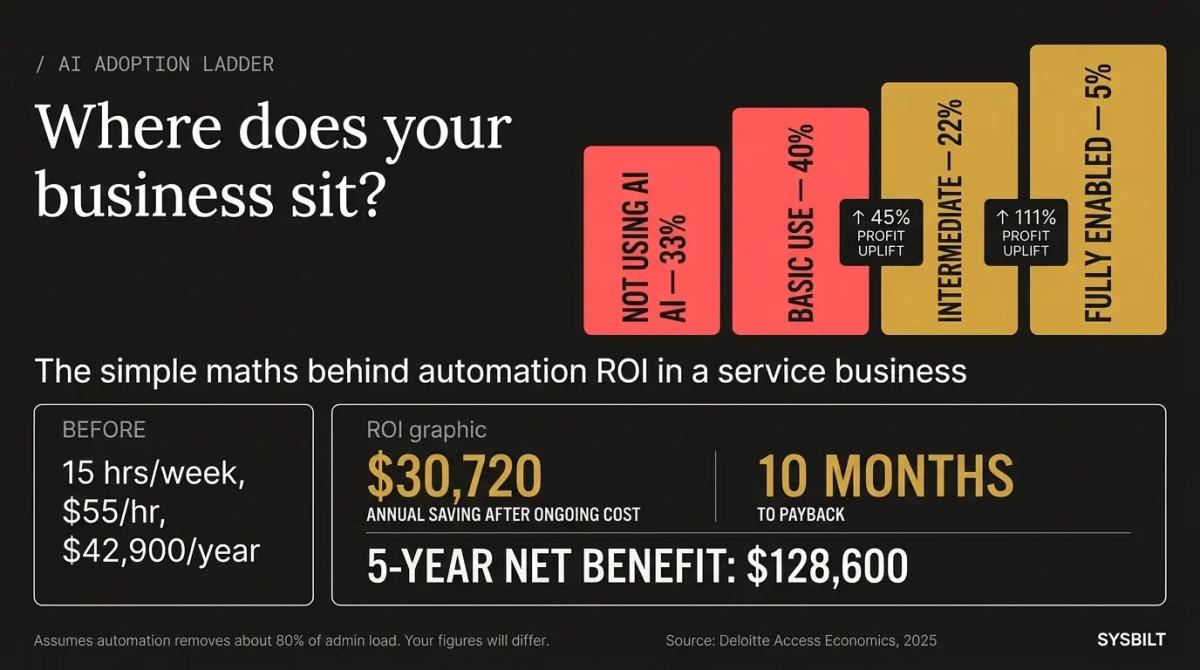
Just 5% of the Australian small and medium businesses using AI were assessed as fully enabled to realise its benefits (Deloitte Access Economics, 25 November 2025, checked October 2026). The distance between where most businesses sit and where the returns start compounding is smaller than you think. But it requires a system, not a shopping list.
The Three Stages of Business Automation (and Where You Fit)
Automation isn't one project. It's a sequence that matches where your business actually is right now. Trying to build dashboards before you've fixed your lead flow is like putting a speedometer on a car with no engine.
Stage 1: Get Clients
Your website captures leads. Your CRM organises them. Automation follows up before the prospect forgets your name.
If you're losing enquiries because you can't answer the phone while you're working, this is where you start. A lead comes in, gets a text back within a minute, and enters a pipeline that tracks every conversation. You don't need to remember to follow up because the system already did it. This is where Websites & E-commerce, CRM & Lead Tracking, and Automation work together as a single capture loop.
For most businesses in the $1M to $3M range, this is where the biggest return on automation lives. The arithmetic is simple, though it depends entirely on your own numbers. If you miss two leads a week because nobody answered the phone, and each job is worth $2,000, that is $208,000 a year in enquiries you never got to quote on. Not all of those would have converted, so treat it as the size of the opportunity rather than money lost.
Stage 2: Scale Faster
You've got clients. Now you need to handle more of them without hiring another version of yourself.
AI handles the repetitive questions your team answers fifty times a week. Your content gets created in batches instead of stealing your weekends, and your team actually uses the tools you've paid for because someone built the training into the system from day one. This is the territory of AI Assistants, Content Systems, and Team Training.
Think about the questions your receptionist or office manager fields every day. "What time is my appointment?" "Do you service my area?" "Can I get a copy of my invoice?" These don't need a human. An AI assistant trained on your business can handle them in seconds, across phone, email, and chat, at any hour of the day.
Stage 3: See Clearly
The business is running, but you're still guessing. Data lives in five different platforms and none of the numbers agree.
One dashboard pulls everything together: revenue, lead conversion, job margins, ad spend, and team performance. You open one screen in the morning and know exactly where the business stands. That's Dashboards & Reporting, connected to everything that came before it.
Most businesses at this stage have data in Xero, data in HubSpot, data in spreadsheets, and a vague sense that things are going well. A connected dashboard replaces that vague sense with precision.
Each stage feeds the next. The leads you capture in Stage 1 become the clients you scale in Stage 2, and the data from both flows into the dashboard in Stage 3. This is what turns automation from a disconnected project into a compounding system.
What to Automate First (and What to Leave Alone)
Not everything should be automated. The question isn't "can this be automated?" It's "will automating this give us time, money, or accuracy back?"
The prioritisation framework
Score each process on five factors: how often it happens, how long it takes, how many errors it creates, how many people it touches, and how complex it is to automate. High frequency combined with low complexity equals your first win.
Here's a practical example. If your team sends appointment reminders by text every morning and it takes 20 minutes, that's low impact and low complexity. Easy to automate, but it won't transform the business. If your team spends two hours a day doing data entry between systems, that's high impact and moderate complexity. Automate that one second, after lead follow-up. The framework forces you to rank the opportunities instead of trying to fix everything at once.
The top five starting points for a service business
- 01Lead follow-up. An automatic text or email within 60 seconds of a website enquiry. This alone can recover leads that would have gone to a competitor
- 02Invoicing. Triggered when a job status changes, not when someone remembers to do it
- 03Appointment reminders. SMS or email sent 24 hours before, reducing no-shows without any manual effort
- 04Data entry between systems. Connecting your CRM to your accounting software so nobody types the same client details twice
- 05Report generation. A weekly summary that builds itself from live data instead of someone spending Friday afternoon in a spreadsheet
What to keep manual
Relationship conversations, complex negotiations, and creative decisions should stay human. If a process requires judgement, empathy, or nuance, automate the steps around it but keep a person at the centre. The goal is to free your team from robotic work so they can spend more time on the work that actually needs a human brain.
The Numbers: What Automation Actually Costs and Returns
This is where business owners usually get stuck. You know automation sounds good, but you don't know whether the numbers justify the investment for a business your size.
Take a common scenario, and substitute your own figures as you read. Your team spends 15 hours a week on manual admin: chasing invoices, re-entering data, copying information between platforms, and generating reports by hand. At a loaded cost of $55 an hour, which covers wages plus superannuation and overheads, that is $42,900 a year in labour going toward tasks a system could handle. Both the hours and the hourly rate are assumptions, so the number moves with your business.
Build costs vary widely by scope and provider, so get quotes rather than trusting a range, though for reference our own scoping for a business this size typically lands between $15,000 and $35,000 to set up, with $3,000 to $5,000 a year to maintain (SYSBILT indicative pricing, October 2026). On a $35,000 one-off build, Expeed models payback in about 13 months and a five-year net benefit of around $133,600 (Expeed Technology, Automating Business Processes: A Practical Guide for Australian SMEs, March 2026, checked November 2026). Those are modelled figures from one provider's example rather than measured results, and every number moves with how much admin actually disappears in your business.

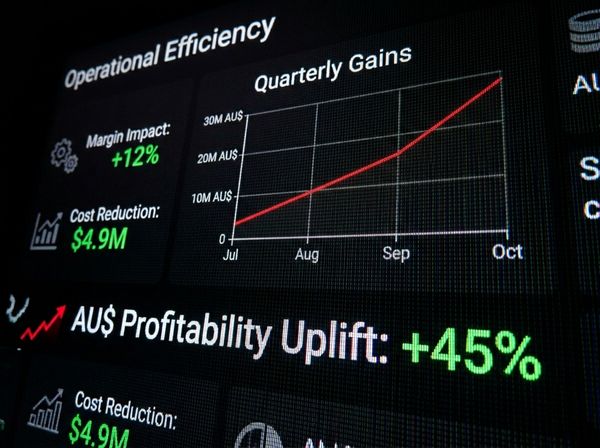
Deloitte's modelling points the same way at a macro level. Small and medium businesses moving from basic to intermediate AI adoption could see profitability rise by around 45%, and those moving from intermediate to fully enabled by around 111% (Deloitte Access Economics, commissioned by Amazon, 25 November 2025, checked October 2026). Those are modelled projections, not measured outcomes, so read them as a direction of travel. Separately, 88% of Australian small and medium businesses using AI report that it is boosting their revenue (Salesforce, Small and Medium Business Trends Report, Australian findings, 2024, checked October 2026). That figure is self-reported by businesses that already chose to adopt, so it tells you how adopters feel rather than what AI caused.
The mistake most business owners make is looking at the setup cost in isolation. They see $25,000 and think "that's expensive." But they don't add up the cost of what they're already paying: the salary hours lost to manual work, the leads that went cold, the invoices that went out late, and the data entry errors that created double-ups.
When you measure both sides, the question stops being "can I afford to automate?" and becomes "can I afford not to?"
A 90-Day Roadmap: From Manual Chaos to Running System
Knowing what to automate is one thing. Knowing how to start without disrupting the business that's already running is another. Here's a 90-day approach that works for businesses in the $1M to $5M range.
Weeks 1 to 2: Audit
List every task your team does more than twice a week. Score each one on time cost, error rate, and automation complexity. You'll find 5 to 10 candidates in the first pass.
Pick the one with the highest impact and the lowest complexity.
Don't overcomplicate this. Walk through a typical week with your team and write down every task that happens more than twice. You'll quickly notice patterns: the same data being entered in two systems, the same email being sent to every new client, the same report being built from scratch every Friday.
Weeks 3 to 6: Build the first automation
Implement one high-value process end to end. Measure the before state, including hours spent, errors, and delays, so you have a real baseline to compare against. This isn't about perfection. It's about proving the concept with real numbers from your own business.
Weeks 7 to 8: Measure and expand
Track the results: hours saved, errors reduced, response times improved. Share the numbers with your team. When people see the proof, adoption gets easier. Pick the next two processes and start building.
Weeks 9 to 12: Connect the system
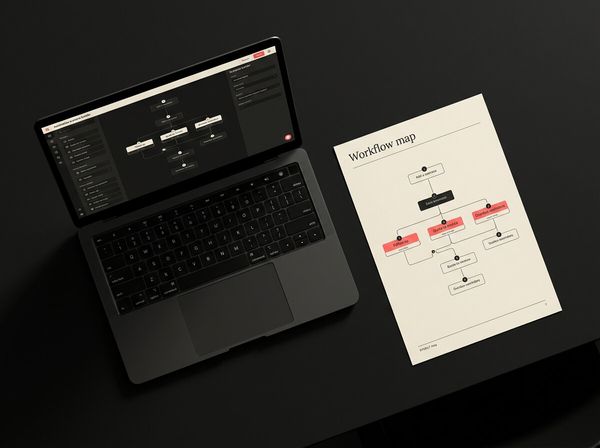
This is where most businesses stop, and it's exactly where the compounding starts. Link your CRM to your automation layer to your reporting dashboard. When a lead converts, the data flows through the pipeline, triggers the onboarding sequence, updates the financial records, and appears on the dashboard without manual handoffs or data re-entry.
By week 12, you've got a working system, not just a collection of tools. And you've got the data to prove it's working.
See how all seven services connect into one system
The Mistakes That Waste Money (and How to Avoid Them)
Automation done badly is worse than no automation at all. These are the traps we see most often.
Automating a broken process. If your quoting process is inconsistent, automating it just means you'll send inconsistent quotes faster. Fix the process first, then automate it. The speed amplifies whatever was already there, good or bad.
Buying tools without training. You spend $20,000 on a CRM, your team finds it confusing, and within three months everyone's back to spreadsheets. Training and documentation aren't optional extras. They're what makes the investment stick. Without proper team training, every tool purchase is a gamble.
Over-automating too early. Some businesses try to automate everything in month one and end up with a fragile system that breaks when anything changes. We've seen businesses invest in a 15-step automation workflow before they've even confirmed the underlying process works.
When the process changes, and it will, the whole thing breaks. Start small, prove it works, and expand from a foundation that's solid.
The "set and forget" trap. Automation still needs a quarterly review. Your business changes, your clients change, and the processes need to evolve with them. Build a calendar reminder to audit your automations every 90 days. It takes an hour and prevents the slow drift that turns reliable systems into unreliable ones.
Where Australian Businesses Go From Here
The gap between businesses that automate and businesses that don't is widening every quarter. With two-thirds of Australian small and medium businesses now using some form of AI and the technology becoming more accessible by the month (Deloitte Access Economics, 25 November 2025, checked October 2026), early movers are building an advantage that compounds over time.
The compounding effect is real. A business that automates lead follow-up this quarter captures more clients next quarter. More clients means more data for the dashboard, and better data means smarter decisions about where to invest, which means higher margins, which funds the next round of improvement. The businesses that start turning this flywheel first pull further ahead every year.
If just one in ten Australian small and medium businesses advanced a single step on the AI maturity ladder, annual GDP could increase by around $44 billion (Deloitte Access Economics, commissioned by Amazon, 25 November 2025, checked October 2026). That's a modelled national figure, not a promise to any one business. It's the combined result of thousands of businesses reclaiming hours, reducing errors, converting more leads, and making better decisions with real data.
The businesses that thrive over the next five years won't be the ones that bought the most software. They'll be the ones that built a connected system: one that captures clients, scales operations, and shows exactly what's working, all without requiring the owner to be in every decision.
That's not a fantasy. It's what happens when you stop treating automation as a one-off project and start treating it as the operating system your business runs on.

WRITTEN BY
Felipe Chaparro
Systems Architect and Founder of SYSBILT. Felipe engineers custom automation, AI workflows, and performance web architectures for scaling Australian service businesses.