Business technology trends for Australian businesses: Payday Super, rising cyber losses, the end of cheques, e-invoicing and AI, and what to do now.
In this article
Vintage put 25 casuals on the payroll this autumn, three restaurant accounts still pay by cheque, and someone in the office clicked a fake invoice link last month. The trend lists you've read talk about AI and the metaverse. The changes that reach a winery this year are more practical.
Here are the business technology trends for Australian businesses that change what you do: five changes, each dated and with an official source behind it, and what to do about each this quarter.
The short answer
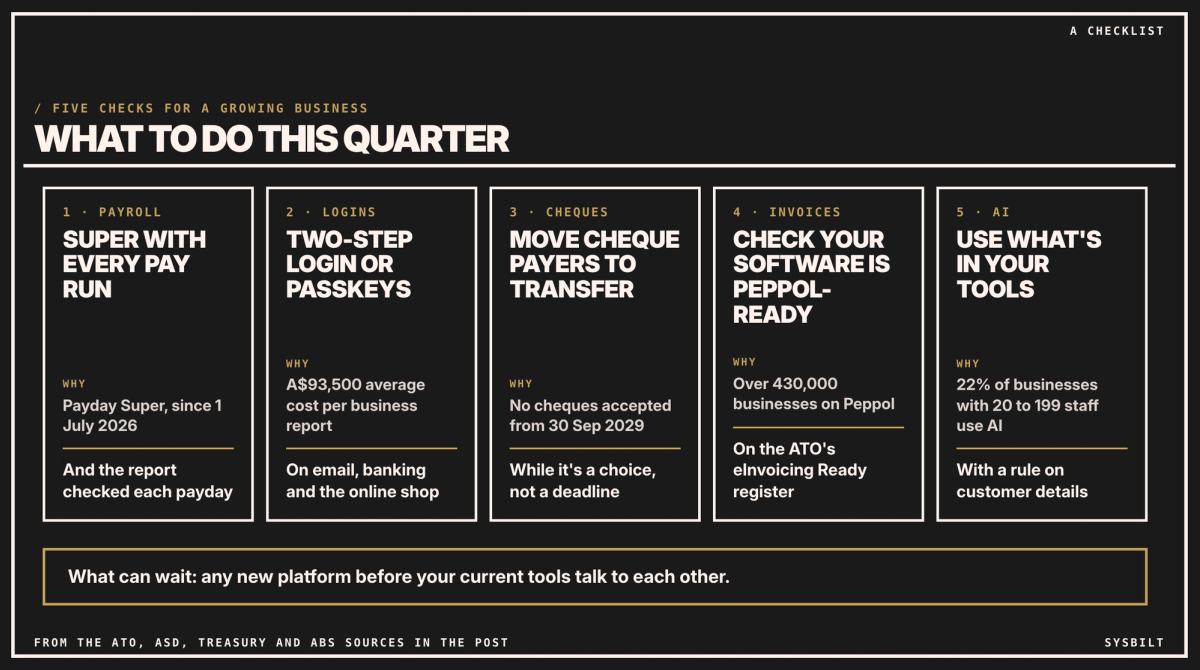
The technology changes that reach a growing business are practical. Super now goes out with every pay, cyber losses keep rising, cheques end in 2029, and e-invoicing is open to any business with ready software. AI matters most inside the tools you already use. Check payroll first, then logins, cheque payers and invoices.
Payday Super is already here
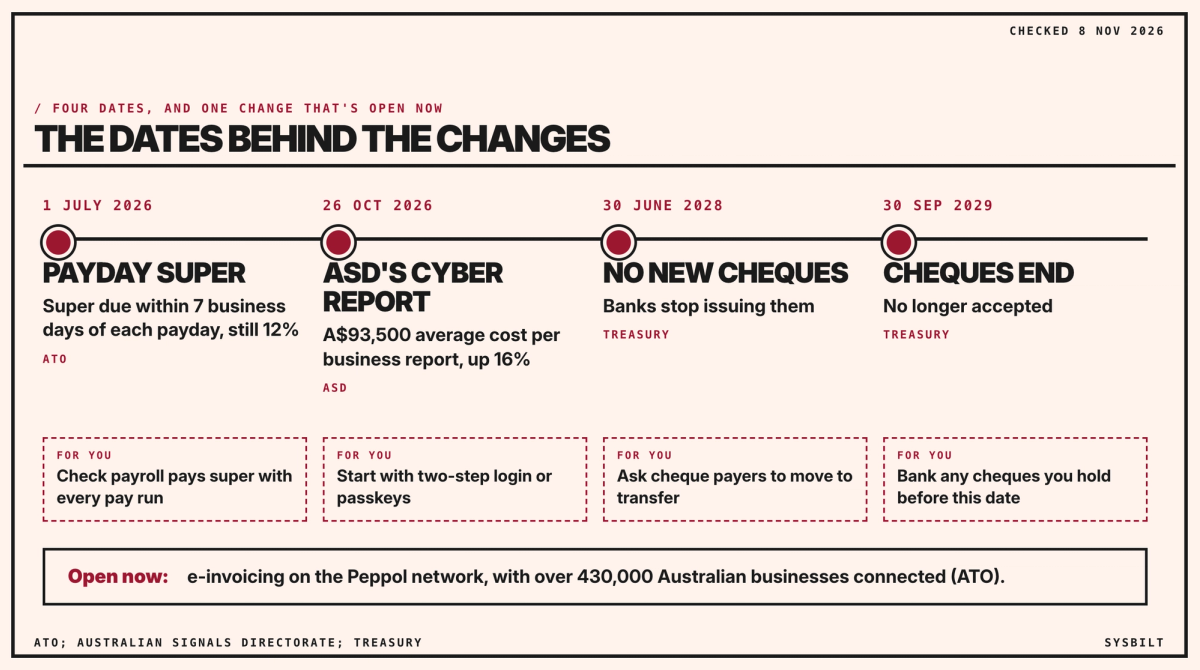
From 1 July 2026, super has to reach your employees' funds within 7 business days of each payday, instead of quarterly. The rate is still 12% (ATO).
It covers casuals as well as permanent staff, so for vintage it means every pay run. Ask your payroll provider one question: does our software send super with every pay run, and does it reach each fund within 7 business days? Then have someone check the report each payday. If your payroll hasn't been doing this since July, fix it now, and ask your accountant about the pay runs since 1 July. The fix may cost money: a payroll upgrade or a clearing house can carry fees, so ask for the price too. If you used the ATO's Small Business Superannuation Clearing House, it closed permanently on 1 July 2026 (ATO), so you've already had to move.
Cyber losses keep climbing
The Australian Signals Directorate's report for 2025-26, published on 26 October 2026, puts the average self-reported cost of cybercrime at A$93,500 per report for businesses, up 16%. For medium businesses, it was A$141,300, up 45% (ASD).
Start with what ASD puts first: multi-factor authentication or passkeys (ASD), on email, banking and the online shop. Then backups you've tested, and updates switched on. Two-step login and updates are usually settings in software you already pay for, so they cost time rather than money; tested backups may need a backup service if you don't have one. And for the fake invoice: before paying anyone whose bank details have changed, ring them on a number you already have, not one in the email. Our post on keeping customer details safe covers breaches and two-step login.
Cheques end in 2029
Banks stop issuing cheques by 30 June 2028, and cheques stop being accepted on 30 September 2029 (Treasury). Cheques already written can still be banked until the second date, but no new cheque books come after the first. Ask the accounts that still pay by cheque to move to bank transfer now, while it's a choice and not a deadline: put your bank details on every invoice and ask them to switch at their next payment. That costs a line on the invoice, nothing more. Bank any cheques you hold before 30 September 2029.
E-invoicing is open to any business
Peppol is the network e-invoices travel on: invoices go from your software to your customer's, with nothing to print, email or type in again, and over 430,000 Australian businesses are on it (ATO). Ask your accounting software provider whether it's eInvoicing Ready, or look it up on the ATO's product register (ATO). If it is, ask whether sending e-invoices costs extra on your plan. For wholesale accounts, it means no PDFs to retype on either side. If your customers aren't asking for it yet, it can wait: check your software first, so you're ready when they do.
AI inside the tools you already use
The ABS found 22% of businesses with 20 to 199 staff used AI in 2024-25 (ABS). Most of it is light use, inside software people already have. Our post on how Australian businesses are actually using AI covers the rest. Turn on the AI in your email, accounts and shop before you buy anything new, with a rule about what customer details can go into it. Some of it comes with your plan and some is an add-on charged per person each month, so check the price before you switch it on for everyone.
What can wait
Anything that needs a new platform before your current tools talk to each other. A new system on top of manual copying makes more copying. Our post on scaling without hiring, under Related articles at the end of this page, shows how to find the admin a system can take first.
Give each check an owner: your bookkeeper for payroll, invoices and cheque payers; whoever looks after your IT for logins; and you for the AI rule.
If you'd rather have help, we check your payroll, logins, payments and invoicing with you and set up what's missing. That's part of our Automation service.
If you'd like a second pair of eyes, book a 15-minute call with our team in Sydney, by phone or video. Bring the list of software you use for payroll, accounts and sales, and we'll check it against these five changes with you, so you leave knowing what to fix first. There's no obligation after the call, and we don't upsell.

WRITTEN BY
Felipe Chaparro
Systems Architect and Founder of SYSBILT. Felipe engineers custom automation, AI workflows, and performance web architectures for scaling Australian service businesses.