How to stop staff answering the same questions every day: count them, write each answer once, send it before people ask, and let an AI assistant take the rest.
In this article
When are levies due? What do our by-laws say about pets? Who do I call about the leak in the car park? Your front desk answers these all day, for owners in 380 strata schemes, and a strata manager gets pulled in whenever the answer depends on the building.
Here's how to stop staff answering the same questions every day: count them for a week, write each answer once, send it before people ask, and let an AI assistant answer the rest from what you've approved, with a person for everything else.
The short answer
Count the questions for a week, then sort them into three kinds: the same for every owner, different for each building, and needing a person. Write the first two kinds down once and send them before people ask. An AI assistant can then answer from those approved answers and hand everything else to your team.
Count the questions for a week
Before you build anything, find out what's being asked. For one week, everyone who answers owners keeps a tally in a shared sheet with four columns: the date, the question, how it came in (phone, email or the website) and who answered it.
At the end of the week, group the same questions together and sort them by how often they came up. The top ten is where you start. Mark the ones that went to a strata manager, because those cost the most time.
Sort them into three kinds
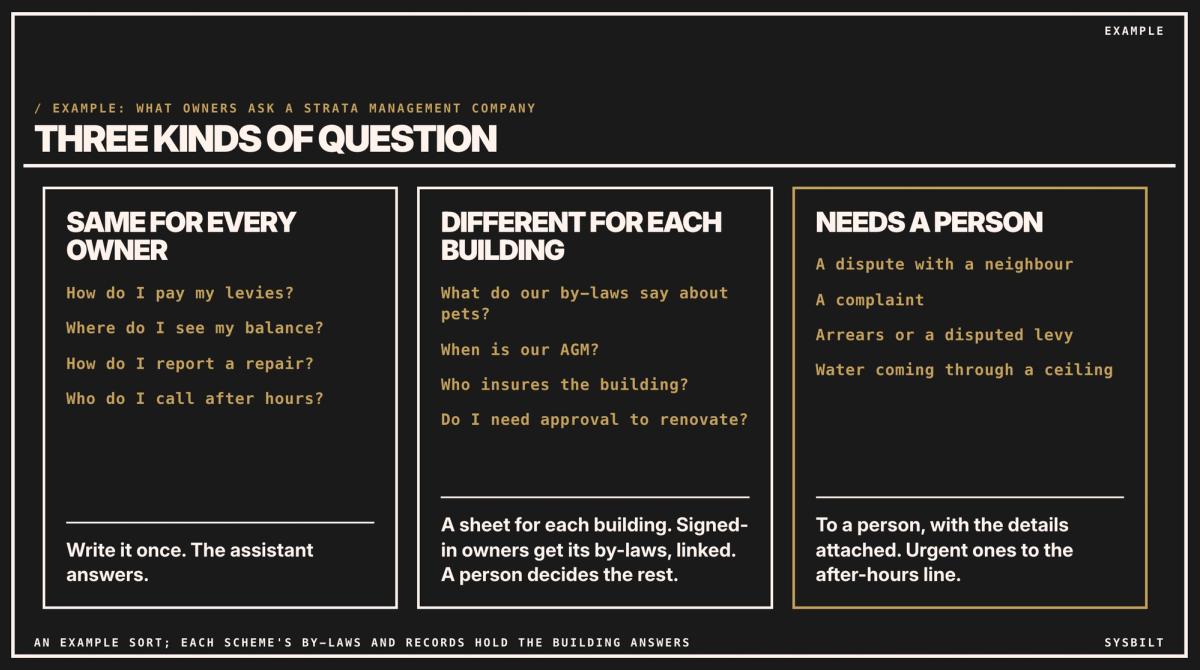
- The same for every owner. How to pay levies and where to see the balance, how to report a repair, who to call after hours, your office hours.
- Different for each building. What the by-laws say about pets, when the AGM is, who insures the building, which renovations need approval. The answer is in that scheme's by-laws and records.
- Needs a person. A dispute with a neighbour, a complaint, arrears or a disputed levy, and anything urgent, such as water coming through a ceiling.
Write each answer once
- One answer for each question, in plain words, approved by the strata manager who knows it best. Keep the answers in one place the whole team can search, such as a shared drive. Our post on Notion vs Google Drive for your company knowledge base covers where.
- A sheet for each building with what owners ask about: the by-laws, the levy due dates, the AGM month, the insurer and the after-hours number. Link the full by-laws rather than summarising them, with the date they last changed. That's real work: at 380 schemes, if each sheet takes half an hour to write and a quarter of an hour to check after each AGM, that's about 190 hours to build and 95 hours a year to keep current (example numbers). A week's tally is too thin to rank 380 buildings, because most won't ring at all, so keep it for a month, or start with your largest schemes and the managers with the most buildings, and add the rest over time.
- An owner and a review date for each, usually the building's strata manager, with a check after each AGM and whenever the by-laws change.
Strata has its own rules. In NSW, strata managing agents need a licence from NSW Fair Trading (NSW Government), and schemes run under the Strata Schemes Management Act 2015. If you manage schemes in other states, strata law and by-law rules differ there, so an answer that's the same for every owner in NSW may not be the same over the border.
Answer it before it's asked
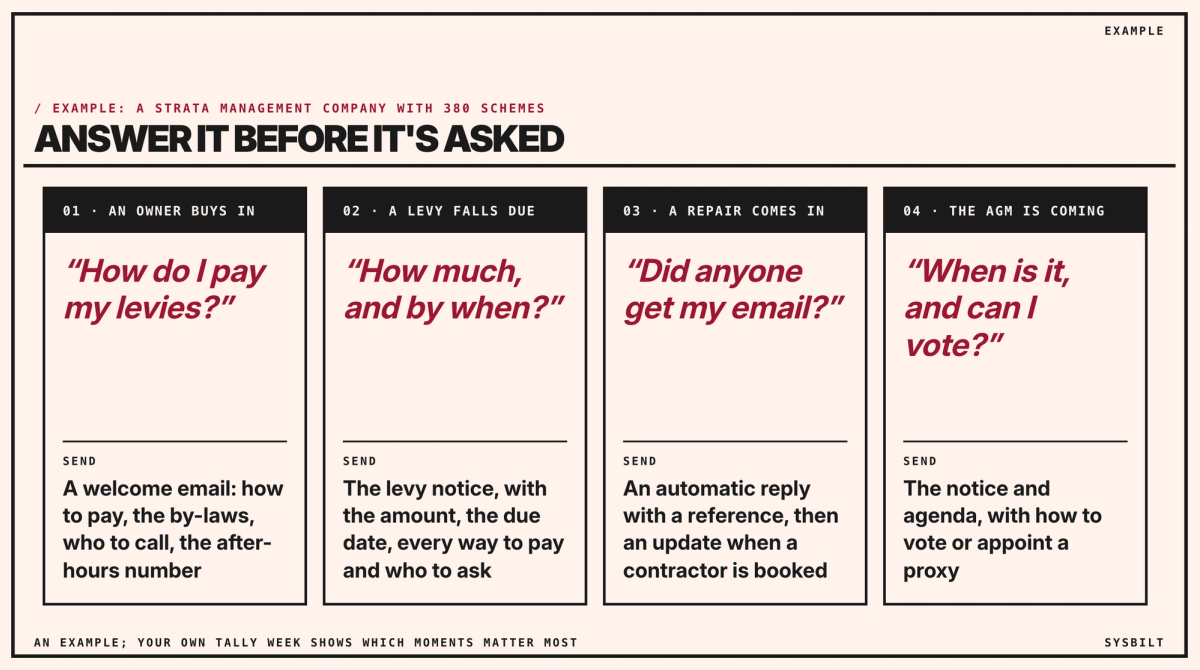
Most of these questions come at the same moments. Send the answer at that moment, and owners don't need to ask.
- When an owner buys in: a welcome email with how to pay levies, the by-laws, who to call and the after-hours number.
- When a levy falls due: the levy notice, with the amount, the due date, every way to pay and who to ask.
- When a repair comes in: an automatic reply with a reference number and what happens next, then an update when a contractor is booked.
- Before the AGM: the notice and agenda, with how to vote or appoint a proxy.
Your strata software may send some of these already. Check what it sends, and what each message says, before you build anything new.
Let an assistant take the rest
Once the answers are written, an AI assistant can answer from them at any hour. On your public website, keep it to the questions that are the same for every owner. If your strata software has an owner portal, put it there for building questions too, because owners have already signed in. In your inbox, start with it drafting replies for your team to check and send. Most tools let you give it your own documents and limit it to those, so it looks up the approved answer and replies in plain words. Website chatbot tools start at about A$46 to A$82 a month, paid yearly, hand-overs included, as our post on building one without coding shows, under Related articles at the end of this page.
Four rules keep it safe:
- It answers only from your approved answers and building sheets. If the answer isn't there, it says it will pass the question to your team.
- Building questions only where it knows who's asking. In the owner portal, the owner has signed in, so it knows the building. On the public website, by-laws and AGM dates aren't public information, so it answers only the questions that are the same for every owner and passes building questions to your team.
- It shares nothing about anyone's account. It can't see levy balances or arrears; it points owners to your owner portal, if your strata software has one, or to your team.
- It hands over anything in the third kind as an email to your shared inbox, with the question, the building and the person's contact details, so nobody has to ask twice. Urgent ones get the after-hours number straight away.
Here's how it might go. At 8pm, an owner in a building in Merewether, signed in to your owner portal, asks whether she can keep a dog. The assistant sends her building's by-law on pets, with the date it last changed, and says the owners corporation decides any request, so her strata manager will follow up. She asks for her levy balance, and it points her to the balance page in the portal rather than giving a figure. Then she mentions water coming through her bathroom ceiling: it gives her the after-hours number and sends the details to your shared inbox.
You answer for what it says. Under the Australian Consumer Law, businesses mustn't mislead customers (ACCC), so treat its answers as your own.
Owners' names, lots and levy accounts are personal information. The privacy regulator's advice is not to put personal information, especially sensitive information, into publicly available AI tools (OAIC). Use a business tool, ask where it stores conversations, in Australia or overseas, and check that fits your privacy policy.
Before it goes live, run your tally week's questions through it and check every answer. For the first month, someone reads every conversation. Our post on whether to put an AI chatbot on your website covers what it should answer and how to try one.
Check it's working
A month after you start, keep the same tally for a week and compare it with the first. Then read what the assistant handed over: a question that keeps coming back is an answer you haven't written yet.
If you'd rather have it built, we build AI assistants that answer from your approved answers and hand the rest to your team. That's our AI Assistants service.
If you'd like a second pair of eyes, book a 15-minute call with our team in Sydney, by phone or video. Bring a week's tally of the questions your team answers, and we'll sort your top ten into the three kinds with you, so you leave knowing which answers to write first and which an assistant could take. There's no obligation after the call, and we don't upsell.
See how we fix this
See the exact system we build to fix this
Show me where an AI assistant could take the pressure off
WRITTEN BY
Felipe Chaparro
Systems Architect and Founder of SYSBILT. Felipe engineers custom automation, AI workflows, and performance web architectures for scaling Australian service businesses.