
ServiceM8 vs Tradify for Australian businesses: what each costs your team before GST, Android and no-signal sites, card fees, certificates, and a trial plan.
In this article
You run an electrical contracting business in Newcastle: five electricians, an apprentice and an office manager. The crew does about 120 jobs a month, most of them service calls, with a few small commercial fit-outs. Half of them carry Android phones, some sites have no signal, the office runs Xero, and quotes still go out from a Word template. You've narrowed it to ServiceM8 and Tradify.
Here's ServiceM8 vs Tradify for Australian businesses like yours: what each costs for a team your size, how each handles Android phones and sites with no signal, getting paid on site, certificates and job costing, what you give up with each, moving across, and how to test both in two weeks.
The short answer
ServiceM8 charges by job cards a month with unlimited users, and Tradify charges per person, so for a team of three or more on up to 500 job cards a month, ServiceM8 costs less. Both run on iPhone and Android, but only ServiceM8 works without signal. Tradify Pro includes job costing, which ServiceM8 keeps for Premium.
For a team like yours, seven people with sites out of signal, the price and the offline app point to ServiceM8: Growing, or Premium if you want job costing. The trial checks what the price can't: which one your crew finds easier on the job.
What each costs for a team your size
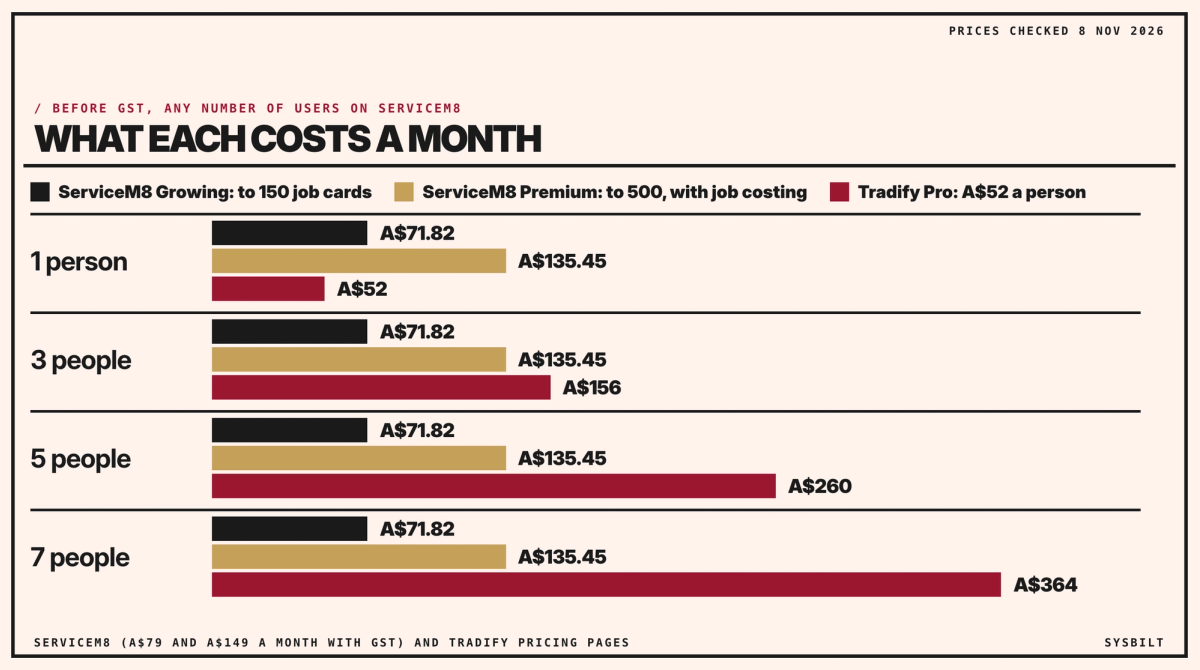
The two charge in different ways. ServiceM8 charges by the number of new job cards a month, with as many users as you like on any paid plan. Tradify charges for each person who logs in, however many jobs you do (ServiceM8, Tradify, both checked 8 November 2026). ServiceM8's prices include GST and Tradify's don't, so the table shows both before GST. If you're registered for GST, that's what you end up paying, because you claim the GST back (ATO).
| Plan | A month, before GST | What the price covers |
|---|---|---|
| ServiceM8 Starter | A$26.36 (A$29 with GST) | Up to 50 new job cards, unlimited users |
| ServiceM8 Growing | A$71.82 (A$79 with GST) | Up to 150 new job cards, unlimited users |
| ServiceM8 Premium | A$135.45 (A$149 with GST) | Up to 500 new job cards, unlimited users |
| ServiceM8 Premium Plus | A$317.27 (A$349 with GST) | 1,500 new job cards, then 20c each |
| Tradify Lite | A$48 a person (A$52.80 with GST) | Jobs, scheduling, quotes, invoices, card payments and accounting sync |
| Tradify Pro | A$52 a person (A$57.20 with GST) | Adds recurring jobs, reminders, progress invoicing, job costing, timesheets, subcontractors and safety forms |
| Tradify Plus | A$62 a person (A$68.20 with GST) | Adds purchase orders, bulk invoicing, reporting and AI tools |
ServiceM8 also has a Free plan for one person and 30 job cards a month. Tradify Pro sits between the two ServiceM8 plans that fit a team like yours: it has job costing, which ServiceM8 keeps for Premium. So compare Pro with Growing if you don't need job costing, and with Premium if you do.
On Tradify, everyone who logs in is a user, the office manager included. Five electricians, the apprentice and the office manager make seven: 7 × A$52 = A$364 a month on Pro, A$4,368 a year. Leave the apprentice off and it's six, A$312 a month; five is A$260. On ServiceM8, all seven log in on any paid plan for the same price.
ServiceM8's price depends on job cards instead. Each new job card uses one, and a quote counts as one; when a customer accepts it and it becomes work, it doesn't use another (ServiceM8). So add the quotes that didn't go ahead to the jobs you did. As an example, 120 jobs and 40 quotes that didn't go ahead make 160 job cards, past Growing's 150, so you'd budget for Premium: A$135.45 a month before GST (A$149 with GST), about A$1,625 a year. Under 150, Growing is A$71.82 a month, about A$862 a year. Go over your plan's limit and ServiceM8 lets you keep working for 7 days, then asks you to move up a plan unless your monthly allowance resets first.
Which costs less depends on both numbers:
- One person: ServiceM8 up to 50 job cards a month (Starter, A$26.36); above that, Tradify Pro (A$52, against A$71.82 for Growing).
- Two people: ServiceM8 up to 150 job cards (Growing, A$71.82, against A$104); above that, Tradify Pro (A$104, against A$135.45 for Premium).
- Three or more: ServiceM8, up to 500 job cards (Premium, A$135.45, against A$156 or more). Past 500, compare Premium Plus (A$317.27) with your Tradify total.
Android phones and sites with no signal
Both run on iPhone and Android. ServiceM8 says its Android app is almost identical to its iPhone app (ServiceM8), but ServiceM8 Phone, its built-in phone system, works on iPhone and desktop only. Tradify runs on iPhone, iPad and Android (Tradify).
Signal is the bigger difference. ServiceM8's app works offline: jobs already synced to the phone can be viewed and updated, with notes and photos, and the changes sync when you're back in range. Final PDF quotes, invoices and forms, certificates included, and emails and texts wait for signal (ServiceM8). Tradify's help centre says both its web console and its app need a live internet connection (Tradify, updated 2024). If your crew works in plant rooms, basements or out past the coverage, test it in the trial: put a phone in flight mode and update a job.
Getting paid on site
Both take card payments on invoices. ServiceM8 takes the card in its app on site, or sends a link to pay online. On Growing, it charges 1.49% + 30c for a standard Australian card, less on higher plans, and pays out the next business day (ServiceM8). Tradify sends a link to pay online, and on site the customer scans a QR code to pay. It charges 1.9% + 30c including GST for a standard Australian card, and pays out 7 days after your first payment, then every 3 days (Tradify).
The fee is yours to absorb now. Surcharges on eftpos, Mastercard and Visa cards ended on 1 October 2026 (RBA), so build card fees into your prices. As an example, A$40,000 a month paid by card in 80 payments costs about A$620 in fees on ServiceM8 Growing and A$784 on Tradify.
Certificates, job costing and subcontractors
From 1 July 2026, NSW electricians must submit certificates of compliance for electrical work (CCEWs) through Building Commission NSW's eCert portal, which replaced the PDF and paper forms (NSW Government). Some job software submits them to it straight from the job (NSW Government), but neither ServiceM8 nor Tradify says on its own pages that it does (checked 8 November 2026). Ask each, and plan on lodging them in eCert yourself until one does.
Tradify's certificates won't cover it either. Its help centre says state rules require some certificates on a specific platform, and the only Australian certificate it lists is Queensland's Certificate of Testing (Tradify). Its Pro plan does include job costing, health and safety forms and subcontractor scheduling (Tradify). ServiceM8 sells pre-made forms in its Form Store on every plan, lets you build your own from Growing, and adds job costing from Premium (ServiceM8). For subcontractors, it either adds them as users with restricted access, which costs nothing more on a paid plan, or sends them work through ServiceM8 Network, where they need their own ServiceM8 account and book the work themselves (ServiceM8). If you test and tag, ServiceM8 keeps a register of each asset and its service history from Growing, and Tradify sends service reminders from Plus.
What you give up with each
Neither is better for every team. Here's what each costs you:
- ServiceM8: a busy month can push you up a plan, because job cards set the price; job costing waits for Premium; forms from its Form Store are bought; and its phone system works on iPhone and desktop only.
- Tradify: every login adds A$52 a month on Pro; nothing works without signal; its only Australian certificate is Queensland's; texts cost 20c each, where ServiceM8 includes 300 a month on Growing; and card payments reach your account more slowly.
Moving your quotes, customers and Xero across
ServiceM8's quote and invoice templates are Word documents: you download one, edit it in Word and upload it again, so your current layout can carry over, though ServiceM8 suggests this for people comfortable with Word's advanced features (ServiceM8). Tradify Pro builds quotes from its own templates, with your logo and colours (Tradify).
For customers, ServiceM8 syncs clients with Xero, and Tradify takes a customer list as a CSV file. Both connect to Xero, MYOB and QuickBooks Online: ServiceM8 syncs clients, items, invoices and payments (ServiceM8), and Tradify syncs with all three from Lite (Tradify). In the trial, have your office manager check that an invoice and its payment arrive in Xero with the right GST code.
Where both stop
Both chase quotes and unpaid invoices for you now: ServiceM8 on every plan, Tradify from Pro (ServiceM8, Tradify). Neither is a sales pipeline, though. If tenders and fit-outs become a bigger share of your work, a CRM (customer relationship management software) tracks each one by stage and value; our post on HubSpot vs Pipedrive compares two.
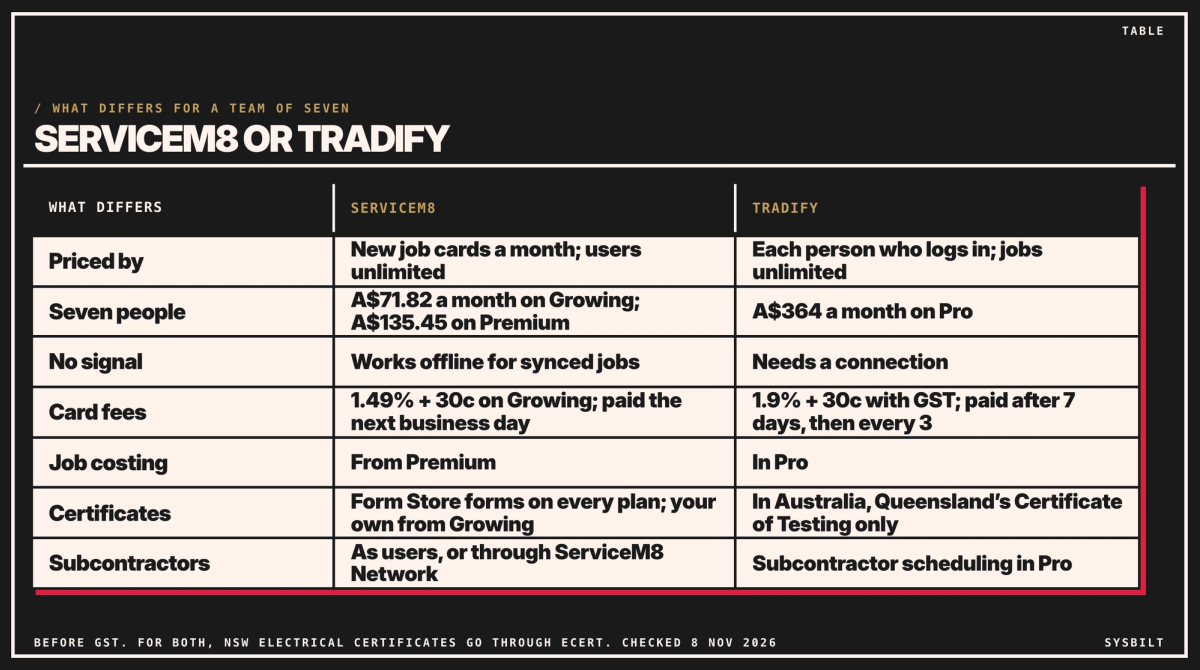
Here's what differs, side by side.
How to test both in two weeks
Both have 14-day trials with every feature, and neither locks you in: ServiceM8 lets you change plans at any time, and Tradify is month to month. ServiceM8's trial doesn't need a card (ServiceM8, Tradify).
- 01Before you start, count last month's new job cards, quotes included, and the people who'd log in. Price both from those two numbers.
- 02Ask each whether it submits CCEWs to eCert yet, and how you'd get your data out if you leave.
- 03Run both on the same week of real work, with two electricians on each: one on an iPhone, one on Android.
- 04On a site with no signal, update a job and add a photo.
- 05Load your quote template and twenty customers, connect Xero, send three invoices and take one card payment.
- 06Choose on your price first, then on which one the crew kept opening.
If you'd like a second pair of eyes, book a 15-minute call with our team in Sydney, by phone or video. Bring last month's job and quote count and who'd log in, and we'll work out what each would cost you and what to test in the trial, so you leave knowing which to try first. There's no obligation after the call, and we don't upsell.

WRITTEN BY
Felipe Chaparro
Systems Architect and Founder of SYSBILT. Felipe engineers custom automation, AI workflows, and performance web architectures for scaling Australian service businesses.