What an AI receptionist for Australian businesses takes on, what it costs next to a hire, what it must never decide, and what to set up first.
In this article
At your Brisbane agency, two front-desk staff take about 60 calls a day, most from tenants asking when the rent is due, when the next inspection is, or whether their repair has been booked. At the morning and lunchtime peaks, calls ring out, and you're weighing a third hire against an AI receptionist.
Here's what an AI receptionist for an Australian business like yours can take on, what it costs next to a hire, what it must never decide, and what to settle before you switch it on.
The short answer
An AI receptionist answers the calls your team can't get to, handles routine questions, takes details and passes the rest to a person. For about 200 missed calls a month, one Australian provider charges A$250 a month plus GST, against about A$72,000 a year with super for a full-time receptionist, who also does far more.
What an AI receptionist does
- Answers when your team can't, in your agency's name, at the peaks and when someone's on leave.
- Handles routine questions from the information you give it: when rent is due and how to pay, inspection times, office hours, how to report a repair.
- Takes details: the caller's name, the property and what they need.
- Passes calls to a person, either straight away or as a message marked urgent.
- Sends your team a summary of each call, so nobody has to ring the tenant back to ask what they wanted.
It answers from what you give it, so it's only as good as your answers. A tenant asking something it doesn't know gets a callback, not a guess. Questions about a tenant's own repair or rent balance need a connection to your property management software, and that isn't in the prices below. For most tenants, "is my repair booked?" is the routine question, so ask each provider whether it connects to your software and what that adds. Without it, the AI takes the details and a person rings back.
What it costs next to a hire
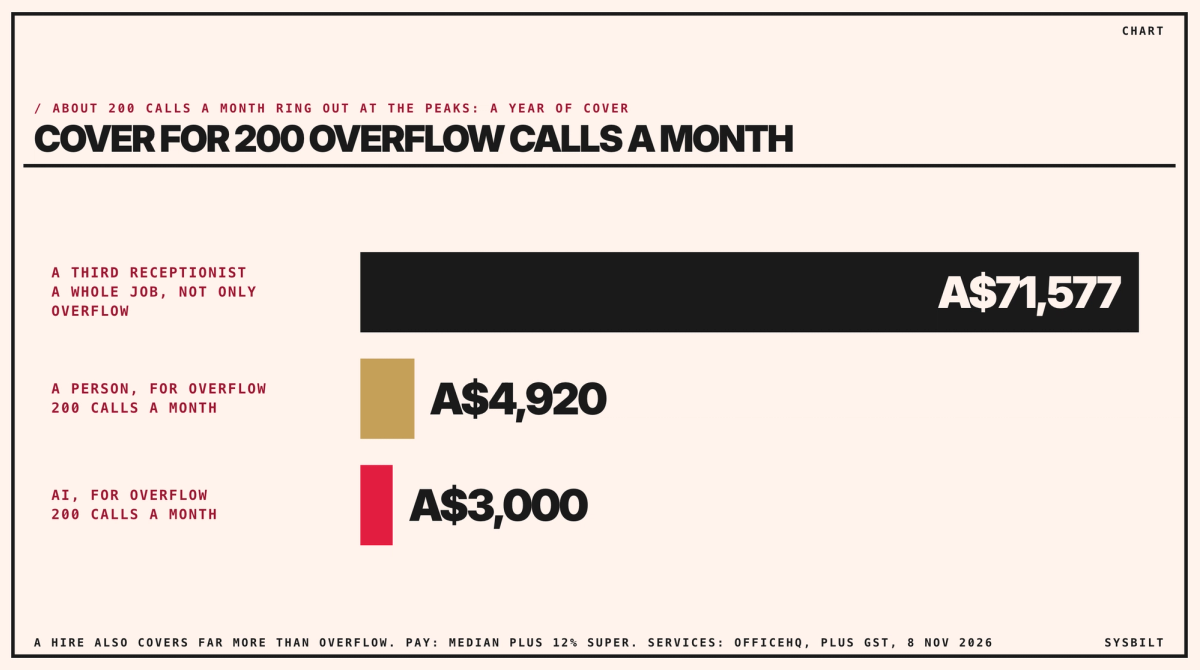
Used this way, an AI receptionist is overflow answering: it takes the calls your team can't get to, not the whole desk. As an example, say about 10 of your 60 calls a day ring out at the peaks, so about 200 a month. Count your own before you decide. If you wanted it to answer every call first, that's about 1,200 a month, above the provider's published plans, so you'd ask for a price.
| Another receptionist | A live answering service for overflow | An AI receptionist for overflow | |
|---|---|---|---|
| Cost | About A$71,577 a year full-time: median pay plus 12% super | MessageExpress 200 at one provider: A$410 a month for 200 calls, or A$4,920 a year, plus GST | MyAI Receptionist 200 at the same provider: A$250 a month for 200 calls, or A$3,000 a year, plus GST; A$1.50 a call above 200 |
| Hours | Office hours, less leave | 8am to 6pm on weekdays; more with an after-hours surcharge | Any hour you send it calls; here, the morning and lunchtime peaks |
| Knows your agency | Deeply, in time | From a script | From what you give it |
| Best at | Anything that needs judgement | Messages and transfers | Routine questions, details and hand-overs |
The pay is the median for a full-time receptionist, A$1,229 a week before tax (Jobs and Skills Australia), plus the 12% super guarantee (ATO), before workers' compensation and cover for leave. The service prices are OfficeHQ's, an Australian provider that publishes both, checked 8 November 2026: its AI receptionist and its live message-taking. The same provider sells both: people who answer in your name, and an AI that does. Its plans run month to month, with no lock-in contract. Its prices are plus GST, which a GST-registered business claims back, so they compare directly with pay. Others charge by the minute or by the call, so ask each for a price on your own numbers.
A third receptionist does more than answer overflow. But if the problem is 200 calls a month at the peaks, overflow answering costs a small fraction of a hire, before any connection to your property management software.
What it must never decide
- Emergency repairs. In Queensland, the law lists them: a burst water service, a blocked or broken toilet, a gas leak, a dangerous electrical fault, flooding, a failure of the water, gas or electricity supply, and more (RTA). Anything that sounds like one never goes into tomorrow's list. Set it up like this: the AI transfers the call to your on-call number; if nobody answers, it gives the caller your emergency contact or the nominated repairer from the tenancy agreement, and sends your on-call person a text and an email at once.
- Money and disputes. Arrears, bond claims and complaints go to a person.
- Anything it doesn't know. It takes the details and says who will ring back, and when.
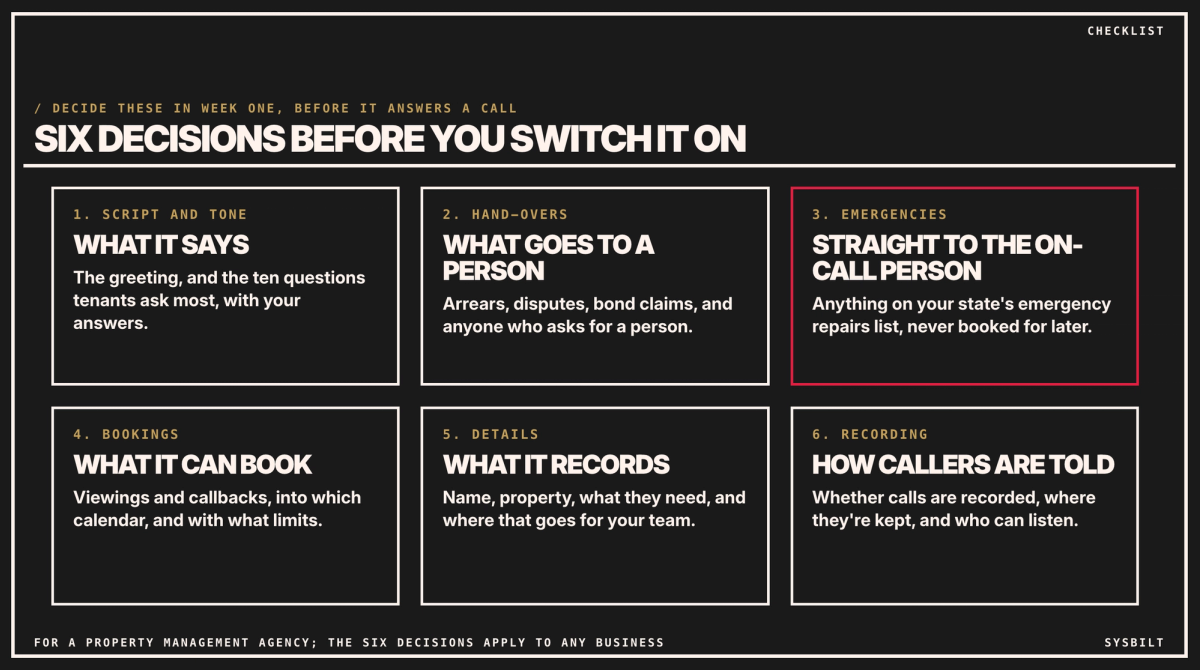
Six decisions before you switch it on
- 01Script and tone: the greeting, and the ten questions tenants ask most, with your answers.
- 02Hand-overs: what goes to a person, and what happens if nobody picks up the transfer.
- 03Emergencies: Queensland's list, or your own state's if you manage rentals elsewhere, and who's on call.
- 04Bookings: what it can book, such as viewings and callbacks, into which calendar, and with what limits.
- 05Details: what it records on every call, and where that goes for your team.
- 06Recording: whether calls are recorded, where recordings are kept, who can listen and for how long. Tell callers at the start of the call that it's recorded.
Recording: whether calls are recorded, where recordings are kept, who can listen and for how long. Tell callers at the start of the call that it's recorded. That isn't only courtesy: the privacy regulator's guide for health services says that under federal interception law and state and territory listening devices laws, recording a call without telling the caller is illegal (OAIC).
Before you sign, ring the provider's trial number from somewhere noisy, speak quickly, and say "there's water coming through the ceiling". It passes if it treats that as an emergency within a sentence or two and transfers you or gives the emergency number. It fails if it offers to book a routine repair or takes a message for tomorrow.
How you'll know it's working
Track five numbers for the first month, against two weeks of counting before you start:
- Calls that ring out, before and after.
- Calls handled without a person.
- Hand-overs to a person, and whether they were the right ones.
- Time to ring back the calls that needed someone.
- Complaints about the calls, if any.
If calls stop ringing out and your team rings back faster, it's doing a receptionist's work. If you still need the call-backs answered after hours, our post on after-hours phone answering compares AI and a person at night, and our post on AI that books meetings covers the booking side.
Start this week
- 01Count the calls that ring out at the peaks, every day for two weeks.
- 02Write down the ten questions tenants ask most, and your answers.
- 03Write the emergency list for your state, with who's on call and the nominated repairers.
If you'd rather have it set up, we set up AI receptionists that answer from your own information, hand over to your team and log every call. That's part of our AI Assistants service.
If you'd like a second pair of eyes, book a 15-minute call with our team in Sydney, by phone or video. Bring your two weeks of missed-call counts, and we'll tell you whether AI or another person fits, so you leave knowing what to try first. There's no obligation after the call, and we don't upsell.

WRITTEN BY
Felipe Chaparro
Systems Architect and Founder of SYSBILT. Felipe engineers custom automation, AI workflows, and performance web architectures for scaling Australian service businesses.