How Australian businesses actually use AI: what the ABS, the National AI Centre and the Reserve Bank found, and where a firm like yours should start.
In this article
Two of your brokers already use ChatGPT on their own, a software rep told you last week that most of your competitors use AI, and your fellow directors want a plan. Before you spend anything, you want to know what Australian businesses like yours actually do with it.
Here's how Australian businesses are actually using AI right now, from the three sources that measure it: the Australian Bureau of Statistics, the National AI Centre and the Reserve Bank. They disagree on how many businesses use it, and the two that ask what it's used for both find mostly light, everyday use.
The short answer
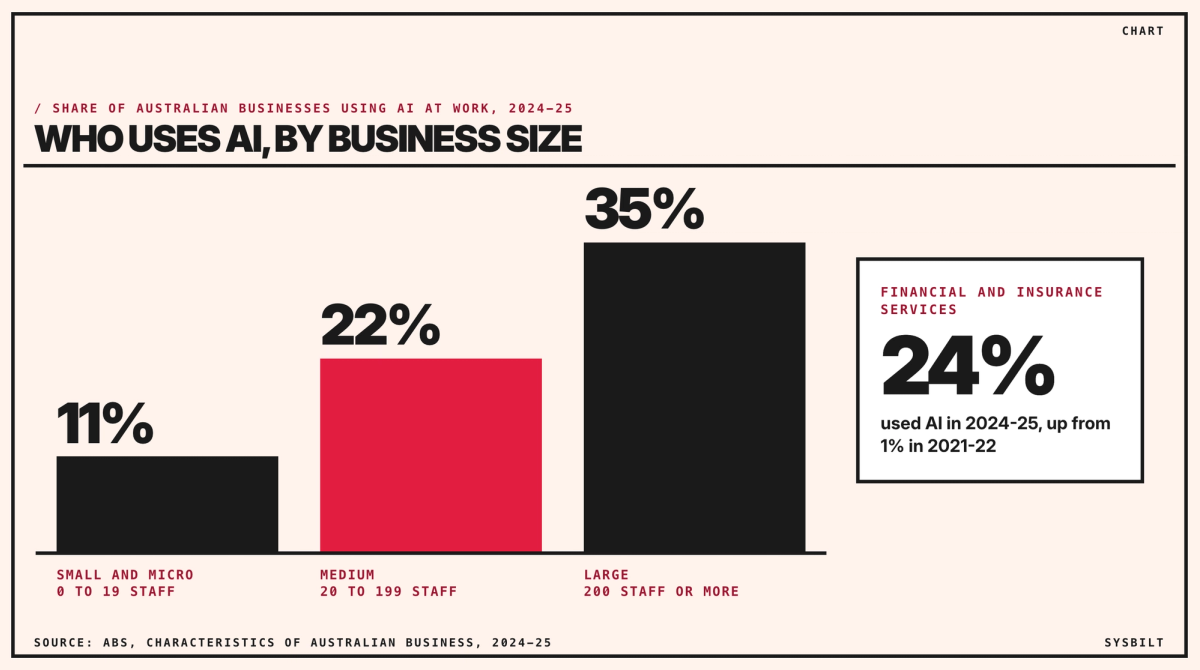
Most Australian businesses that use AI use it lightly, to draft text, summarise and analyse. The ABS found about 12% of businesses used AI in 2024-25, and 22% of businesses with 20 to 199 staff. The National AI Centre's survey, which counts one-off use, puts small and medium businesses at 43%.
Three surveys, three answers
Ask how many Australian businesses use AI and you'll get three different numbers, because three surveys ask different businesses different questions.
| Survey | Who it asked | When | What it found |
|---|---|---|---|
| ABS, Characteristics of Australian Business | Nearly 7,000 businesses of every size | October 2025 to February 2026, about 2024-25 | About 12% used AI at work; 22% of businesses with 20 to 199 staff |
| National AI Centre, SME AI Pulse | At least 400 small and medium business owners a month | December 2025 to February 2026 | 43% reported some use of AI, one-off use included |
| Reserve Bank, survey of firms it meets regularly | 105 medium and large firms | June to August 2025 | Two-thirds had adopted AI in some form |
The figures come from the ABS, the National AI Centre and the Reserve Bank, read on 7 November 2026.
They differ because they count differently. The ABS asked whether a business used AI at work, the National AI Centre counts any use, one-off included, and the Reserve Bank asked only larger firms. For a firm your size, the closest comparison is the ABS: 22% of businesses with 20 to 199 staff used AI in 2024-25. In financial and insurance services, 24% did, up from 1% in 2021-22. That's the number for your directors: about one in five firms like yours, and most of them, as the next section shows, use it lightly. Even the broadest count isn't climbing fast: the National AI Centre's figure was 45% the quarter before, and 44% in February. "Most of your competitors" doesn't hold.
What "using AI" usually means
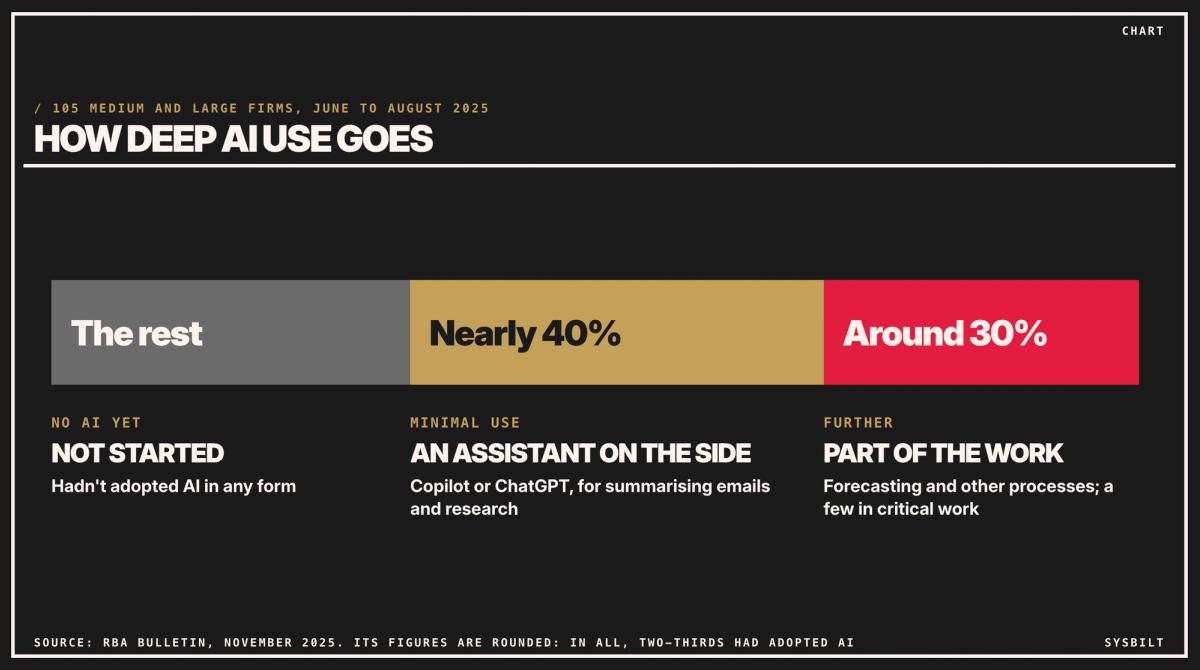
In the Reserve Bank's survey, two-thirds of the firms had adopted AI. Nearly 40% of all the firms used it minimally: off-the-shelf assistants such as Microsoft Copilot or ChatGPT, for summarising emails and research. Around 30% had gone further and used it in some business processes, such as forecasting, and a smaller group had built it into critical work, such as fraud detection. Those are the bank's rounded figures, which is why together they come to a little more than two-thirds. Use was often led by employees rather than by the business, and the firms said the returns had been mixed so far.
Small and medium businesses look similar on content and analysis: among those using or planning to use AI, 54% use it to produce content and 54% to analyse data. They also report a use the Reserve Bank's firms didn't describe: 48% use it for cybersecurity and threat detection. More complex uses, such as AI agents, which carry out several steps on their own, remain "largely untapped". And only about half of the businesses using AI check what it produces before it affects a customer.
Why the rest haven't started
Among small and medium businesses with no plans to use AI in the next 12 months, around 65% don't trust its decisions or want people to stay in control, and 54% say it isn't relevant to them. Counted across all small and medium businesses, not just those with no plans, 19% say they don't know how to use it.
Each of those has an answer. If you don't trust its decisions, don't hand it any: keep a person checking anything that reaches a client, and start with work only your own team sees. If it doesn't seem relevant, look at the writing and summarising your team does every week, such as renewal emails and file notes. And if you don't know how, start with one task: what it teaches you becomes the strategy.
What this means for a brokerage like yours
- Your brokers are probably using it already. As in the Reserve Bank's survey, use often starts with staff, not the business, so nobody may know what has gone into those tools. Ask who uses what, and for which work.
- Keep client details out of public AI tools. The privacy regulator's advice is not to put personal information, especially sensitive information, into publicly available AI tools (OAIC). If you use a paid business plan, read its terms on your data before anyone pastes in a client's file.
- If client details have already gone in, stop it, write down what went in and when, and assess it with the OAIC's guide to data breaches. Under the Privacy Act, a breach likely to result in serious harm must be reported to the people affected and to the OAIC (OAIC).
- Bring compliance in early. Brokers hold, or work under, an Australian financial services licence, and ASIC's 2024 report "Beware the gap" reviewed how 23 licensees use AI and govern it (ASIC). Its title is the message: the rules and checks have to keep pace with the use. Show your compliance adviser and your professional indemnity insurer the one-page rule below before you widen use.
- Know what can go wrong. A summary can leave out or misread something that matters, such as an exclusion in a policy wording. That's why a broker checks every summary against the wording before relying on it.
- Start where a broker already checks the work: a summary of a long policy wording for the broker's own use, a renewal email the broker edits before it goes, or call notes turned into a file note.
For example, if a renewal email takes a broker 15 minutes to write, and 5 minutes to check once AI has drafted it, 300 renewals a month give back 50 hours. That's an example to test against your own timing, not a promise.
When you're ready to go further, our post on AI agents explains the step after an assistant, and our post on answering customer emails with AI shows one task done well.
What the one-page rule says
- Approved tools: the ones the business pays for, and nothing else for client work. Before approving one, check in its terms whether it uses your data to train its models, and where it stores it.
- Never goes in: client names, policy numbers, claims details and health information.
- Always checked: a broker reads anything AI drafted before it reaches a client.
- Who to ask: one named person, for questions and for any new tool.
Start this week
- 01Ask your team what they already use AI for, and whether any client information goes into it.
- 02Write the one-page rule and show it to your compliance adviser.
- 03Pick one task that a broker already reviews, and time it for a month before and after.
If you'd rather have it set up, we build AI assistants into the systems your team already uses, with a person checking before anything reaches a client. That's part of our AI Assistants service.
If you'd like a second pair of eyes, book a 15-minute call with our team in Sydney, by phone or video. Bring the three tasks that take your brokers the most time, and we'll tell you which ones AI handles well today, so you leave knowing where to start. There's no obligation after the call, and we don't upsell.

WRITTEN BY
Felipe Chaparro
Systems Architect and Founder of SYSBILT. Felipe engineers custom automation, AI workflows, and performance web architectures for scaling Australian service businesses.