What AI agents for business are, how they differ from assistants and automations, what one could do with your orders, and four questions to ask first.
In this article
Every morning, three of your team open the orders inbox, read about 80 emails from cafés and restaurants, and type each order into the inventory system. A software rep told you an AI agent could do it. You want to know what that actually means, and whether you can trust it with your customers' orders.
Here's what AI agents for business are, how they differ from the assistants your team may already use, what one could do for a distributor like yours, and the four questions to answer before you switch one on.
The short answer
An AI agent is software that can plan and carry out several steps on your behalf, such as reading an order email, checking stock and drafting the order, rather than just answering a question. Before you switch one on, decide what it can access, what it can do, what it can approve, and who stays accountable.
What an AI agent is
The National AI Centre describes an AI agent as "a type of AI system that can plan and carry out multi-step tasks on your behalf, rather than just responding to individual prompts" (National AI Centre). The Reserve Bank describes systems that, once running, "can make some designated decisions and solve problems relatively autonomously" (Reserve Bank).
| An assistant | An automation | An agent | |
|---|---|---|---|
| What it does | Answers or drafts when someone asks | Runs the same steps whenever a trigger fires | Works out the steps to reach a goal, within limits you set |
| For your orders | Drafts a reply to a café when a staff member asks | Turns a web order form into an order, the same way every time | Reads each order email, matches the products, checks stock and drafts the order |
| Who starts it | A person, each time | The trigger | The goal; then it works through the queue |
| How it goes wrong | A wrong answer a person can see | A step that breaks when something changes | A wrong order sent to the warehouse, unless a person approves it first |
Watch the label. The National AI Centre heard that some products sold as agents are ordinary automations underneath. That isn't bad in itself, but it changes what can go wrong.
Few businesses use agents yet
Agents are still early. The National AI Centre's survey of small and medium businesses found them "largely untapped" in early 2026, and the Reserve Bank found growing interest among larger firms, but "practical adoption of such tools so far has been low". If you haven't started, you're not behind. Our post on how Australian businesses are actually using AI has the full picture.
What an agent could do for a distributor like yours
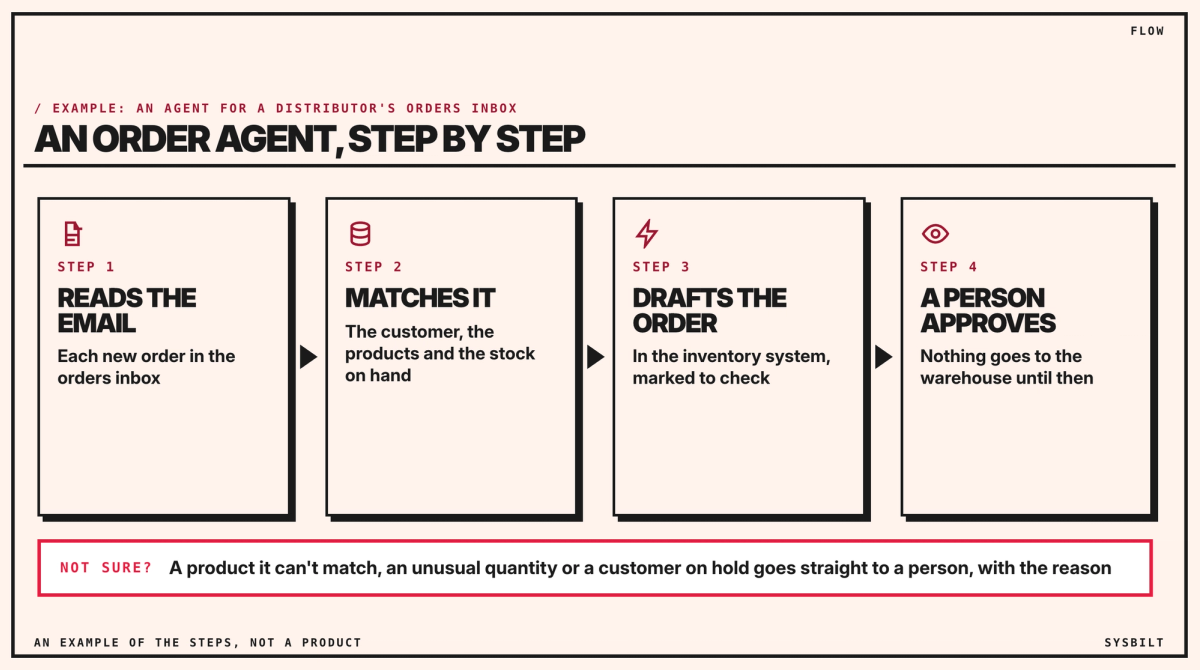
Here's how an agent for your orders inbox would work. It's an example of the steps, not a product.
- 01It reads each new order email.
- 02It matches the customer, the products and the stock on hand.
- 03It drafts the order in the inventory system, marked to check.
- 04A person approves it before anything goes to the warehouse.
Anything it isn't sure about, such as a product it can't match, an unusual quantity or a customer on hold, goes straight to a person, with the reason.
Messy emails are the real test. "The usual, plus two of the dark roast" only works if the agent can see that customer's past orders, and whatever it can't match goes to a person. Once a person approves an order, invoicing carries on the way it does now. Phone orders stay with your team unless the call itself is answered by AI, which is a different tool, covered in our post on AI receptionists.
Which raises the first question: do you need an agent at all? If most orders come from the same regular customers ordering from a fixed product list, an order form or a reorder link, plus an automation that turns each form into an order, may be cheaper and more predictable. It also fails where you can see it, as a form that won't submit, rather than as a wrong order in the warehouse. An agent earns its place when orders keep arriving as emails in your customers' own words, and they won't move to a form.
For example, if typing an order takes 4 minutes and checking a draft takes 1, 80 orders a morning go from about 5 hours 20 minutes of typing to 1 hour 20 minutes of checking. That's an example to test with your own timing, not a promise. What your three people do with the rest of the morning, such as phone orders and the customers who need a person, is your call. Tell them early what's changing and why.
Four questions before you hand it the work
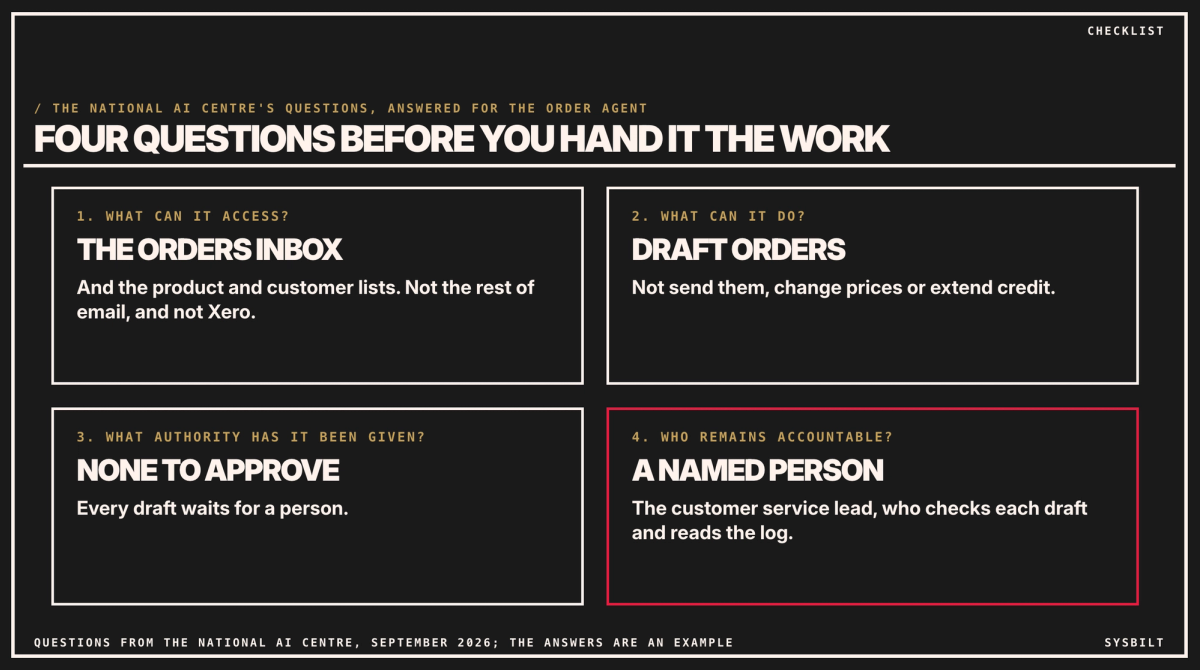
The businesses the National AI Centre spoke to put it simply: "It's a delegation problem, more than a technology problem." Before you switch an agent on, answer its four questions.
- What can it access? The orders inbox and the product and customer lists. Not the rest of your email, and not Xero. A separate mailbox for orders makes that easy to enforce.
- What can it do? Draft orders. Not send them, change prices or extend credit.
- What authority has it been given? None to approve. Every draft waits for a person.
- Who remains accountable? A named person, such as your customer service lead, who checks each draft and reads the log: the record the tool keeps of each email it read and each draft it made.
Two more points from the same sessions. A person in the loop only works if they have the training, the time and the power to step in: they know the products and the customers, they have time set aside each morning, and they can pause the agent or change its rules. And the risk changes as the tool, your process and its permissions change, so review it regularly, using the log.
What needs to be in place first
- Your lists are right. The product list, prices and customer list the agent matches against are current, and someone owns keeping them that way. An agent working from an old price list makes the old mistakes faster.
- The steps are written down, including the odd cases: substitutions, split deliveries, and customers who ring and then confirm by email.
- The person who checks has the time. In the example, that's more than an hour every morning, set aside, not squeezed in.
How to start
- Start with drafts a person approves, for one queue, for a month. Track two numbers: minutes per order, and the share of drafts that needed fixing.
- Widen what it can do only when fixes are rare, such as fewer than 2 in every 100 drafts for four weeks running (an example threshold, so set your own), and one step at a time.
Questions for the rep
Agent features are turning up inside software many businesses already pay for, and in tools sold on their own. Whoever is selling, ask:
- Which of our systems does it connect to, and how? It needs the inventory system. Ask whether access to everything else, such as Xero, can stay switched off.
- What can it read and change, and can we limit it to one mailbox and one kind of action?
- Where are our customers' emails processed and stored? Those emails carry your customers' names and contact details. If your business turns over more than $3 million a year, the Privacy Act covers it, and under Australian Privacy Principle 8 you stay responsible for how an overseas provider handles them. The answer to want is a named location and data processing terms that commit the provider to protect that information, which the privacy regulator says is generally how you meet that duty.
- What happens when it's unsure, and who sees it?
- Where's the log, and can we read it without asking you?
- What does it cost each month, and does the price rise with the number of orders?
We haven't put a price on an agent in this post because the market hasn't settled: some tools charge per user, some per action or message, and some fold agents into a plan you already pay for, so quotes rarely compare like for like. Compare each one against what the work costs now. In the example, four hours a morning is about 84 hours a month over 21 working days, which at A$35 an hour plus super is about A$3,300 (example numbers). The agent and its setup have to come in well under that.
Start this week
- 01Pick one queue that's high in volume and low in risk, such as the orders inbox.
- 02Write down the steps a person follows today, including the odd cases.
- 03Answer the four questions for that queue, and name the person who checks.
If you'd rather have it built, we build agents that draft rather than decide, with a person approving each action and a log of what the agent did. That's part of our AI Assistants service.
If you'd like a second pair of eyes, book a 15-minute call with our team in Sydney, by phone or video. Bring the queue you'd hand over first, and we'll tell you whether it's ready for an agent, so you leave knowing what to fix first. There's no obligation after the call, and we don't upsell.
See how we fix this
See the exact system we build to fix this
See how AI assistants work for your business
WRITTEN BY
Felipe Chaparro
Systems Architect and Founder of SYSBILT. Felipe engineers custom automation, AI workflows, and performance web architectures for scaling Australian service businesses.