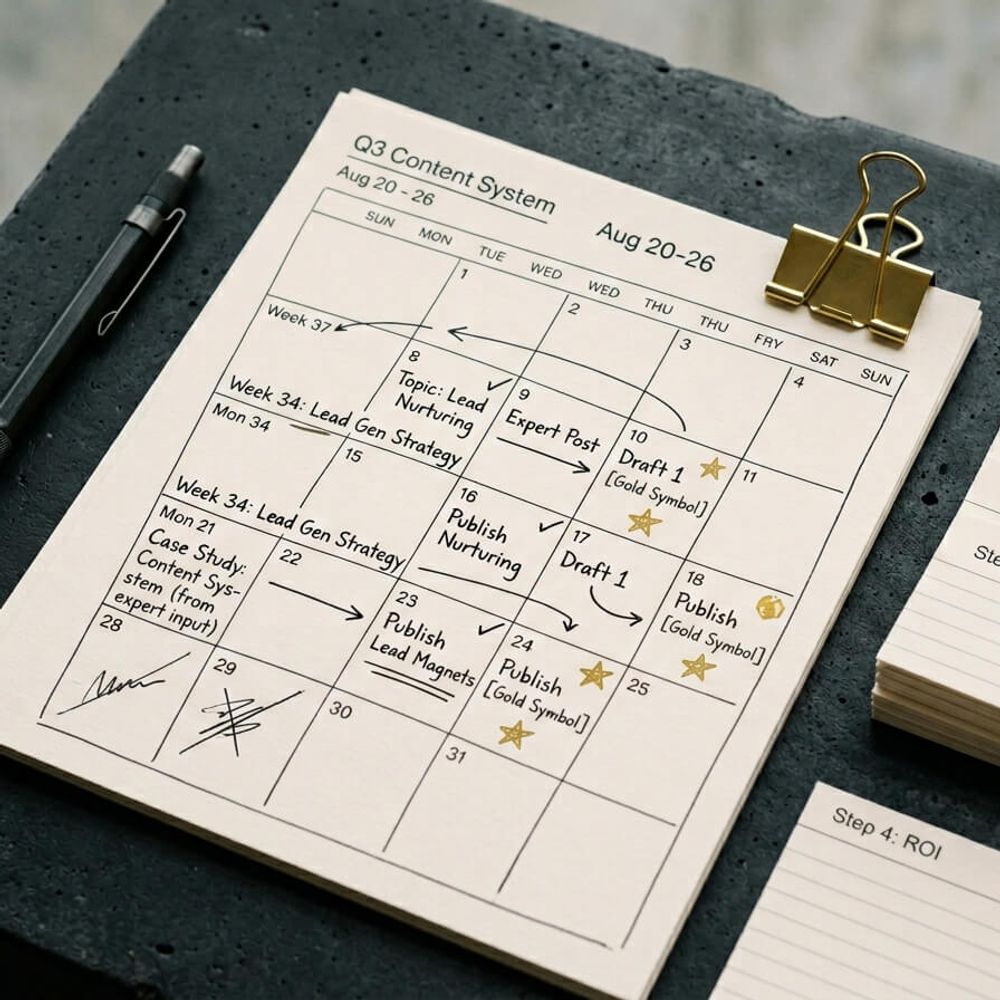
A B2B content strategy for a service business: the questions to answer, how often to post, how one conversation fills a month of content, and what to measure.
In this article
Your consultants answer the same questions for clients every week: what the Essential Eight is, whether a penetration test is worth it, what the cyber insurer will ask for. None of those answers is on your website. Two of the team posted on LinkedIn for a month, then got busy, and it stopped.
Here's a B2B content strategy for a commercial service business like yours: what to publish, how often, how one conversation can feed a month of posts, and how to tell whether it's bringing in work.
The short answer
List the questions your clients ask before they hire you, and answer one a fortnight in a blog post built from a 20-minute conversation with the consultant who knows it best. Turn each post into LinkedIn posts and a line in a monthly email, and count enquiries, not likes.
Buyers read about you before they call
In Gartner's latest survey of 646 business buyers, run in 2025, 67% said they'd rather buy without talking to a salesperson. So a prospect is likely to read about you before they ring: your website, a LinkedIn post, an answer Google showed them. A content strategy decides what they find.
Start with the questions your clients ask
- Ask each consultant for the five questions clients ask most in a first meeting. Check the inbox and the last ten proposals too.
- Keep them on one list, with the consultant who knows each answer best.
- Write for one reader: the operations or finance manager at a mid-sized company who has to decide what to do about cyber security, not another security expert.
That list is your plan. At one question a fortnight, twelve questions last six months.
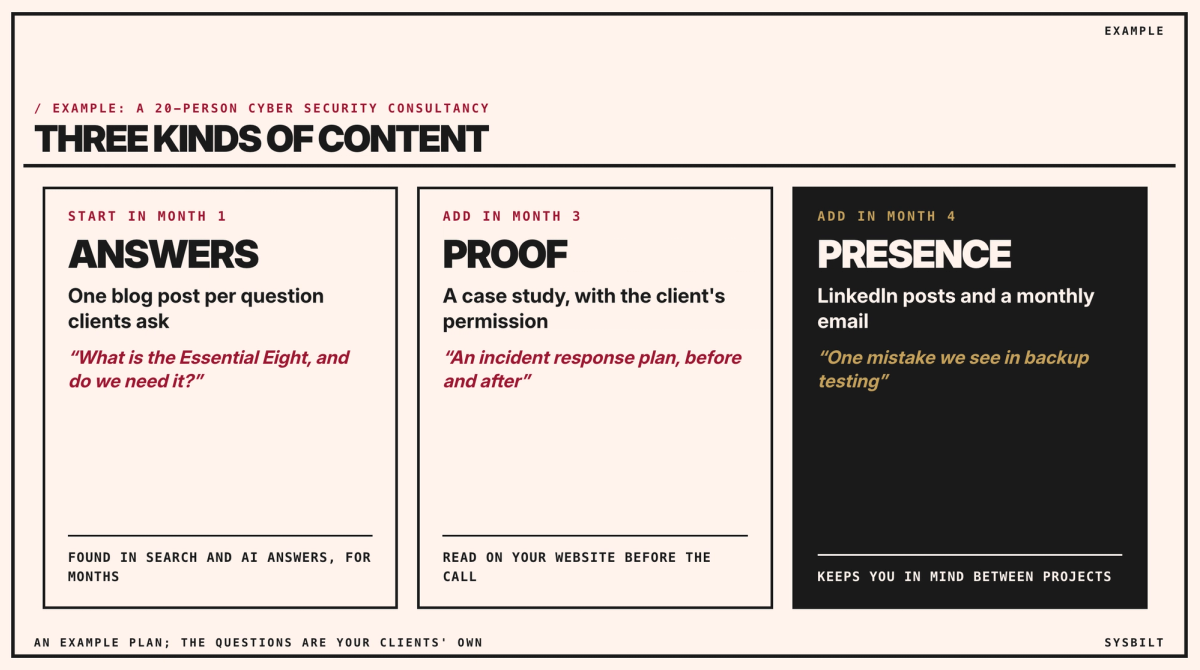
Three kinds of content
- Answers: one blog post per question. These are what people find in search, and they keep working for months. Google takes the links in its AI Overviews from pages it can already show in ordinary search, so a page that answers a question well can be quoted in an AI answer too (Google).
- Proof: a case study of what changed for a client like them, with the client's permission. Our post on how to format a business case study for your website covers how to write one.
- Presence: LinkedIn posts and a monthly email that keep you in mind between projects.
Start with answers. Add a case study in month 3, once a client is happy to be named, and presence in month 4, once the posts are coming out on time.
One conversation, many pieces
Your consultants don't need to write. They need to talk.
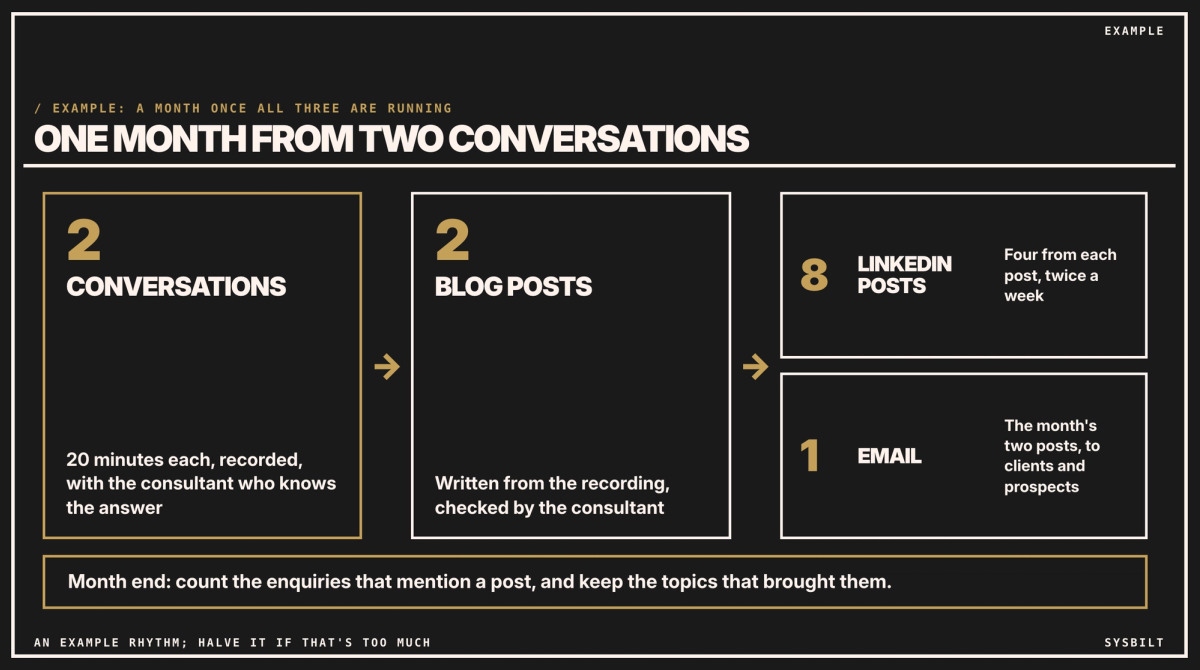
- 01Record a 20-minute conversation with the consultant, about one question from the list.
- 02Write the blog post from the recording. Whoever in the team writes best does it, or a freelance writer if nobody does. As a guide, the rate MEAA, the media union, recommends for 2026 is A$1.12 a word, and about A$1,260 for a piece of up to 1,000 words, before GST, and the Australian Society of Authors, which publishes it, notes that some clients pay significantly less (ASA). An AI tool can turn the transcript into a first draft. Either way, the consultant checks every claim against its original source before it goes out.
- 03Cut four LinkedIn posts from each blog post: the question, the short answer, one example, and one mistake to avoid. Post them twice a week.
- 04Send one email a month to clients and prospects, with the month's two posts.
- 05Sign it off before it goes out. A second senior person reads each piece for three things: nothing that identifies a client without their written permission (names, logos, screenshots, or details that point to them), nothing about a weakness that hasn't been fixed yet, and nothing that reads as advice for one company's situation.
In this example, each blog post takes about 20 minutes of the consultant's time to talk and about as long to check. One person owns the routine, such as your office manager: they book the conversations, chase the drafts and schedule the posts. If a consultant can't spare the time that fortnight, move to the next question on the list. Once all three kinds are running, that's two blog posts, eight LinkedIn posts and one email a month, from two conversations. Our post on how to repurpose one video into a month of content covers how to cut the pieces.
A rhythm you can keep
Put the two conversations in the calendar, on the first and third Monday, and schedule each month's posts a week ahead. Build up to the full month rather than starting with it:
| Month | What goes out |
|---|---|
| 1 and 2 | Two answer posts a month |
| 3 | Two answer posts and a case study |
| 4 to 6 | Two answer posts, eight LinkedIn posts and one email a month |
If that's too much, halve it. A steady half keeps working; a burst that stops after a month doesn't. Give it six months before you judge it.
How to tell it's working
- Ask every new enquiry how they found you, and record the answer in your CRM.
- Check each post in Google Search Console once a month: how often it appeared in search, and how many clicked. Search Console counts appearances in AI Overviews within those same figures, not separately (Google), and an answer quoted in an AI Overview can bring fewer clicks, so judge answer posts more by the enquiries that mention them than by clicks.
- Count the enquiries and proposals that mention a post, not likes or followers.
- After six months, keep the topics that brought enquiries, and drop the rest.
If you'd rather have it set up, we build it with you: the question list, the recording and writing routine, the schedule and the tracking. That's our Content Systems service.
If you'd like a second pair of eyes, book a 15-minute call with our team in Sydney, by phone or video. Bring the questions your clients ask most, and we'll help you pick the first six posts and set the rhythm, so you leave knowing what to publish first. There's no obligation after the call, and we don't upsell.

WRITTEN BY
Felipe Chaparro
Systems Architect and Founder of SYSBILT. Felipe engineers custom automation, AI workflows, and performance web architectures for scaling Australian service businesses.