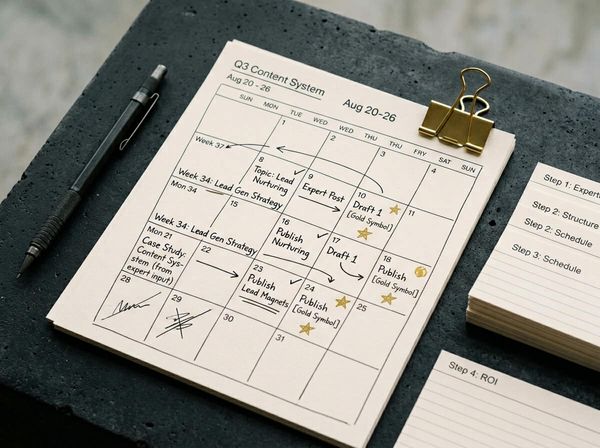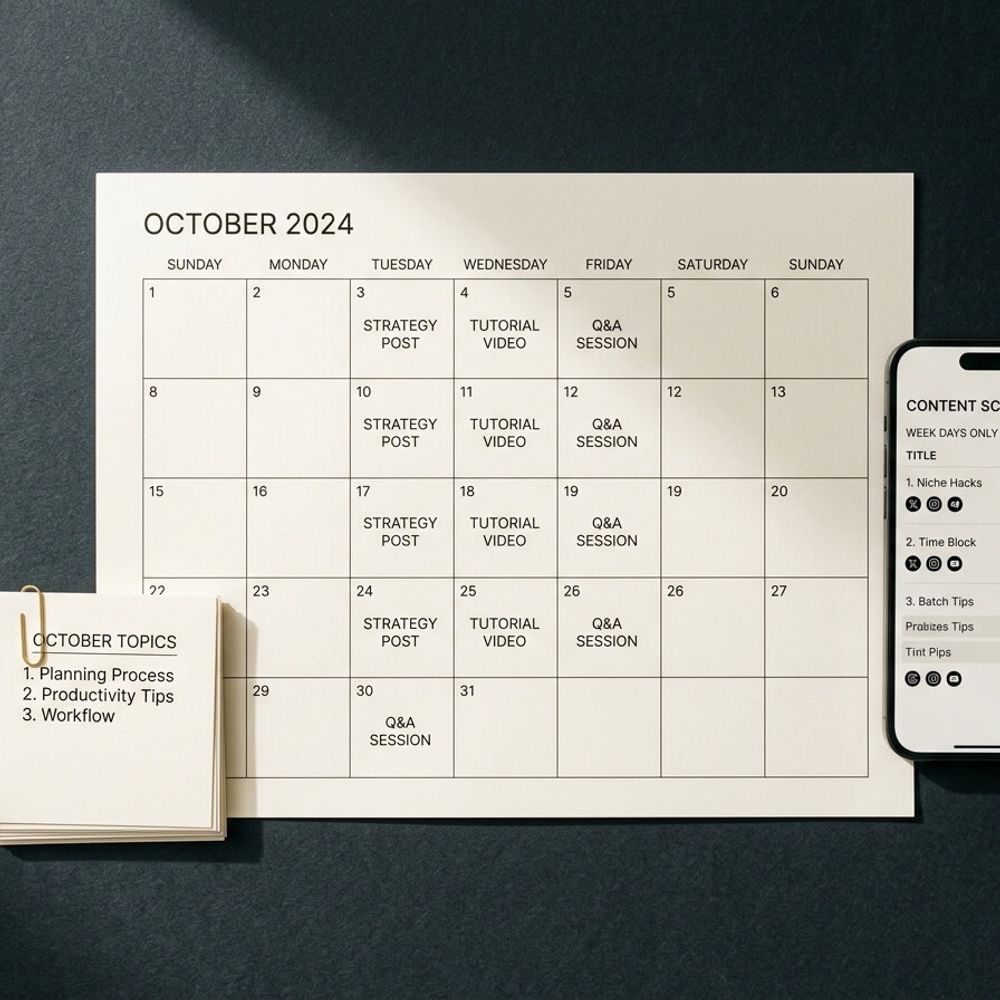
How to create 30 days of content in one afternoon: five pillars, a six-step sprint of about four hours, four templates and a content bank for next month.
Your venue posts in bursts when there's time, then goes quiet for weeks in wedding season, when every Saturday is a wedding and every weekday is planning one. When someone does sit down to post, they start from nothing: what to say, which photo, what to ask people to do.
Here's how to create 30 days of content in one afternoon: pick your pillars, run a six-step sprint of four to five hours, and keep a content bank so next month starts from something.
The short answer
Block one afternoon a month. Pick a theme and one call to action, write thirty one-line ideas, turn the best twelve into short drafts, film a few clips, then schedule three posts a week. Keep every unused idea in a content bank sorted by pillar, so the next sprint starts there.
Pick your pillars first
A pillar is a kind of post you come back to every month, so you never face "what should we post today?" For a venue, five cover most of it:
- Education: what couples ask before they book, such as how many guests the courtyard holds or what happens if it rains.
- Proof: real weddings and events, with the couple's and the photographer's permission before anything is posted. A one-line ask is enough: "May we share a few photos from your day on our Instagram? We'll credit your photographer."
- Behind the scenes: the team setting up, the kitchen at 4pm, a coordinator's checklist.
- Offer: open dates, a venue tour, the open day.
- People: the chef, the coordinators, the team who'll be there on the day.
Thirty days of content means a month covered, not thirty posts: three posts a week is twelve a month. Start there, and add more only once twelve feels easy.
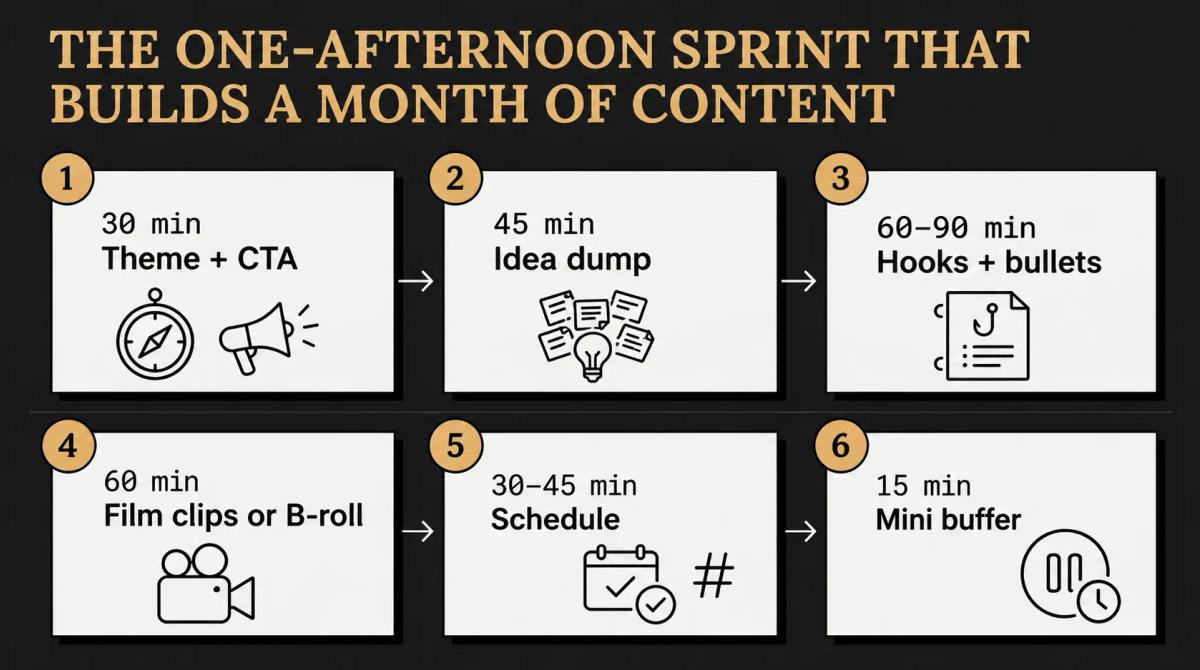
The six-step sprint
Your events coordinator runs the sprint, and you approve the month's twelve posts in one sitting at the end. Block the afternoon in the calendar as you would a client meeting, then work through six steps, in order, without starting the next until the last is done.
- 01Theme and call to action, or CTA (30 minutes). One theme for the month ahead, such as "planning a winter wedding" for a sprint in May, and one call to action, the one thing you want people to do, for every post: "book a venue tour".
- 02Idea dump (45 minutes). Thirty to forty-five one-line ideas, using the pillars as prompts. Lines, not captions.
- 03Hooks and bullets (60 to 90 minutes). For the best twelve: a first line that stops the scroll, three to five bullets, and a closing line with the call to action.
- 04Film clips or B-roll (60 minutes). Six to ten clips of 30 to 60 seconds, filmed on a phone: the courtyard at golden hour, the kitchen plating up, a coordinator's tip. Ask staff before you film them, keep guests' faces out unless they've agreed, and use music your editing tool licenses for business. Not every post needs a clip: the sample month below uses four, and the spares go in the bank. Our post on repurposing one video into a month of content covers how to cut clips that stand alone.
- 05Schedule (30 to 45 minutes). Load the twelve posts into your scheduling tool, three a week, for Instagram and Facebook together, and tag each one with its pillar so you can see the balance. Our post on the best social media scheduling tool for your business compares the options. For Instagram and Facebook alone, Meta Business Suite schedules both at no cost, and the tools in that post add approvals and more channels.
- 06Mini buffer (15 minutes). Pick three to five spare posts from the bank and last weekend's photos, for a week that goes sideways.
In this example, the six steps take four hours to four and three-quarters: a long afternoon.
Here's what the twelve posts can look like for one month:
| Week | Monday | Wednesday | Friday |
|---|---|---|---|
| 1 | Education: what happens to a winter ceremony if it rains | Proof: a fireside reception, with the couple's permission (clip) | Offer: winter Saturdays still open in July |
| 2 | Behind the scenes: setting the barrel room for 120 (clip) | People: the head chef's winter menu | Education: how many guests fit inside when it's cold |
| 3 | Proof: a corporate offsite in the fog | Behind the scenes: lighting the fire pits at 4pm (clip) | Offer: book a winter venue tour |
| 4 | Education: three questions to ask your photographer about winter light | People: our coordinator's day-of checklist (clip) | Offer: the open day, Sunday at 2pm |
That's a sample month on the theme "planning a winter wedding", with one call to action throughout: book a venue tour.
In peak season, run a short version: steps 1, 3 and 5 only, using ideas and clips already in the bank, in two to two and three-quarter hours. Hand it to someone other than the coordinator, such as your front-of-house manager.
Make it repeatable
Keep a content bank
Keep every hook, draft and unused idea in one place, sorted by pillar: a shared folder, a document or a spreadsheet is enough. Each sprint takes from the bank first and adds what's left over, so the next month never starts from zero.
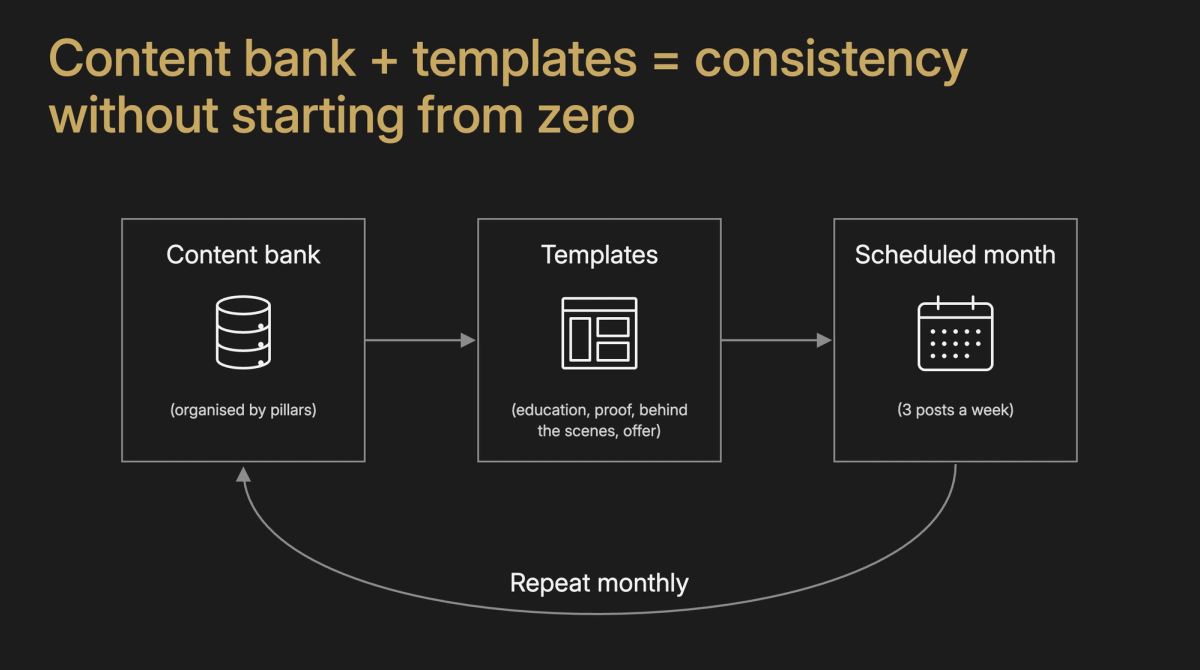
Use four templates
- Education: the question, the answer in a line, one example, the call to action.
- Proof: the event, what the couple or client wanted, how it went, the call to action.
- Behind the scenes: what we did, what we noticed, what we'd do again. People posts use this one too.
- Offer: who it's for, what they get, how to book.
Reply every day
Posting is only half of it. Agree who replies to comments and messages each day, peak season included: a couple asking about a date under a post is an enquiry, and a slow reply can lose it to the next venue.
Check in for 15 minutes a week
One fixed slot a week: check what's scheduled, which post brought the most tour bookings or enquiries last week, more than which got the most likes, and what couples and clients asked about. Add two or three new ideas to the bank from those questions.
When you miss the sprint
Use the buffer for that week, write one education post if you need to, and move the sprint to the next week rather than cancelling it.
If you'd rather have it set up, we set it up with your team: the pillars, the templates, the content bank and the schedule. That's part of our Content Systems service.
If you'd like a second pair of eyes, book a 15-minute call with our team in Sydney, by phone or video. Bring the last month of your posts, and we'll help you set your pillars and next month's theme, so you leave ready for your first sprint. There's no obligation after the call, and we don't upsell.
See how we fix this
See the exact system we build to fix this
Book a call to build a repeatable content system
WRITTEN BY
Felipe Chaparro
Systems Architect and Founder of SYSBILT. Felipe engineers custom automation, AI workflows, and performance web architectures for scaling Australian service businesses.