What happens when your business grows faster than your systems: the five things that break first, what changes past 15 staff, and the order to fix them.
In this article
Three years ago your Perth firm had 12 people and you knew where every survey stood. Now there are 30, with four field crews, and the work still runs through your inbox. Fee proposals wait for your sign-off, invoices go out when someone remembers, and the office keeps three spreadsheets that don't agree.
Here's what happens when your business grows faster than your systems: the five things that break first and the sign of each, how to fix one leak at a time, and what changed on paper as you grew.
The short answer
When a business grows faster than its systems, five things break first: enquiries go cold, handoffs drop steps, invoices go out late, decisions wait for the owner, and the numbers stop agreeing. Find the one costing you most, give it one owner and one number to check weekly, and fix it before the next.
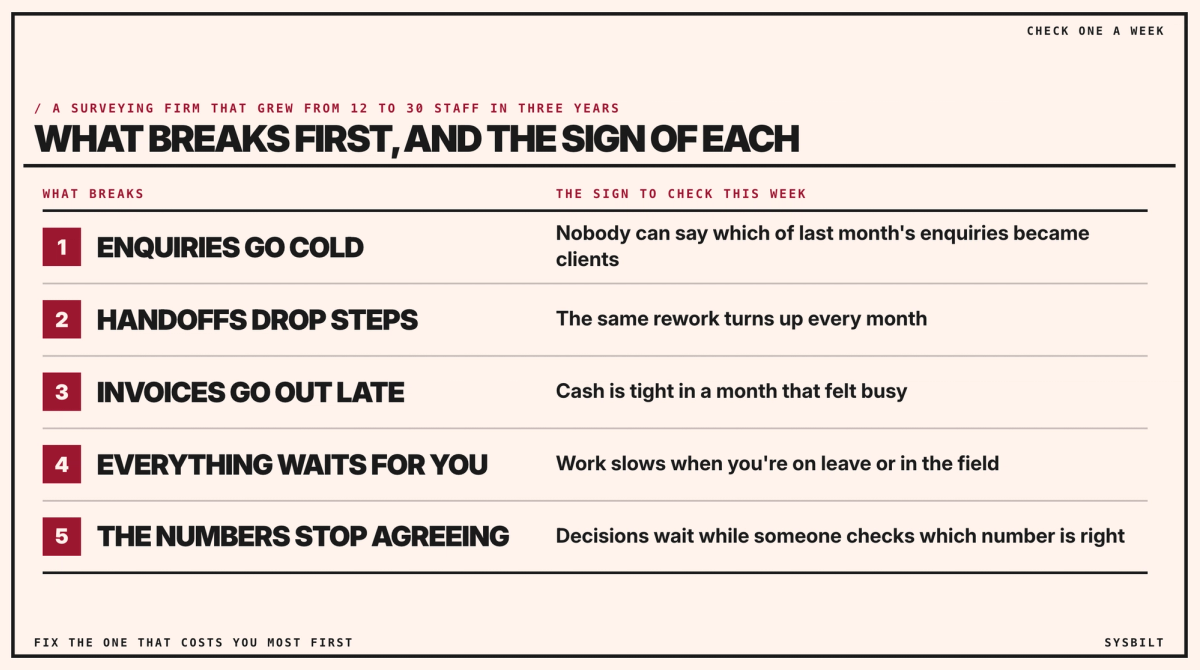
The five things that break first
They rarely break at once, and each has a sign you can check this week.
- 01Enquiries go cold. A form arrives after hours, a call comes in while you're on site, and nobody owns the reply. The sign: nobody can tell you which of last month's enquiries became clients. Our post on stopping missed leads, under Related articles at the end of this page, covers the fix.
- 02Handoffs drop steps. The field crews, the drafters and the office each hold part of the picture. The sign: the same rework turns up every month, and people wait for answers before they can start.
- 03Invoices go out late. The work finishes and the invoice waits for someone to notice. The sign: cash is tight in a month that felt busy. Our post on why a growing business runs short of cash covers the cash side, and our post on automating overdue invoice emails, under Related articles at the end of this page, covers the chasing.
- 04Everything waits for you. Approvals, exceptions and "where's that file" all land in your inbox. The sign: work slows when you're on leave or out in the field. Our post on building a business that runs without you covers stepping back.
- 05The numbers stop agreeing. The CRM, the accounts and a project spreadsheet each give a different answer. The sign: decisions wait while someone works out which number is right.
Fix one leak at a time
The fix isn't more software. It's one leak at a time, starting with the one that costs you most.
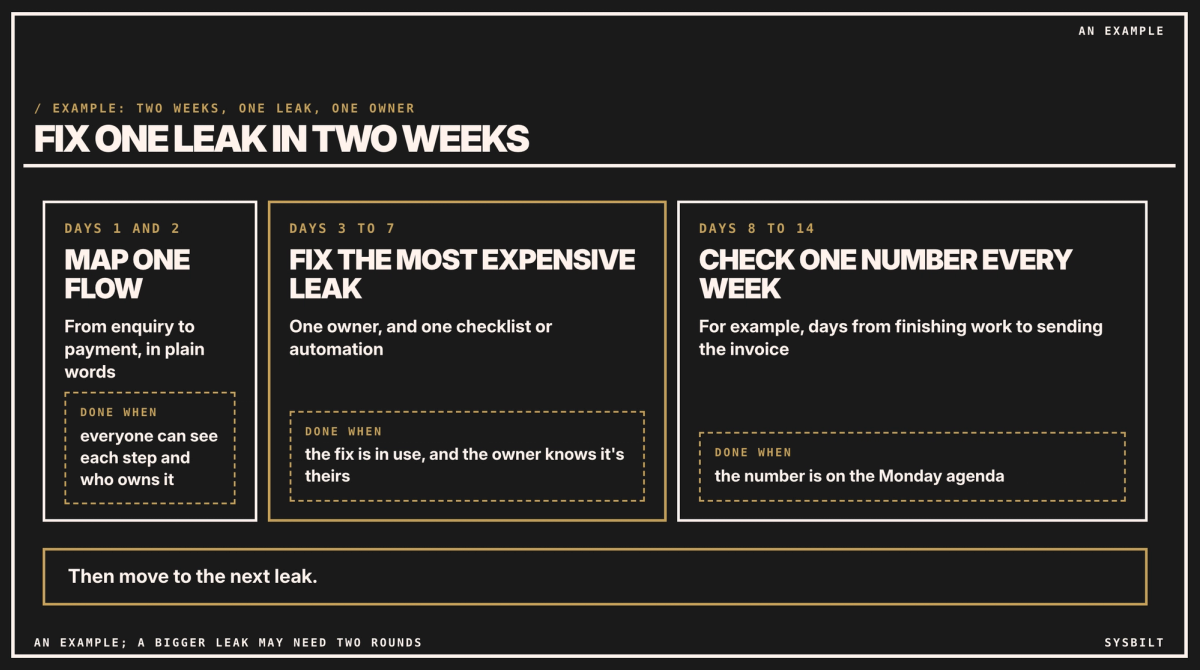
- 01Find the most expensive leak. For one week, count what slips: enquiries without a reply within a day, finished work not yet invoiced, approvals waiting on you. To compare them, put a rough value on each: take last month's finished surveys and add up the ones not yet invoiced, then the fee proposals still waiting. A rough figure is enough.
- 02Give it one owner and one fix. A checklist; an inbox rule that sends every new enquiry to one person; or a simple automation, such as an invoice drafted when a survey is marked finished in the project list. If no one place knows when a survey is finished, that's the first fix. One named person owns it.
- 03Check one number every week. For example: hours to reply to a new enquiry, days from finishing work to sending the invoice, days to be paid, or approvals waiting on you.
- 04Then move to the next leak.
Here are the five leaks filled in for a surveying firm (an example):
| Leak | Owner | Fix | Weekly number |
|---|---|---|---|
| Enquiries go cold | The office manager | Every enquiry, by form, email or phone, lands in one inbox and gets a reply within one business day, with a follow-up task for whoever prices it | Enquiries without a reply after a day |
| Handoffs drop steps | The surveying manager | One handover checklist that travels with each survey, from field crew to drafter to office | Items sent back for rework each week |
| Fee proposals wait for the director | The surveying manager | For the survey types you price often, proposals under a value you set together go out at the standard rates; the rest come to the director with a one-line summary | Proposals waiting more than two days |
| Invoices go out late | The office manager | The invoice goes out the day the survey is marked finished | Days from finishing work to sending the invoice |
| The numbers stop agreeing | The director | One home for each number, such as the accounts for revenue and the project list for work in progress; the spreadsheets copy from those, not the other way round | Numbers fixed by hand each week |
And here's what the first two weeks can look like:
What changed on paper as you grew
Growth changes the rules as well as the workload, and the habits that held at 12 people weren't built for them.
- Ending employment. An employer with fewer than 15 employees has special Fair Work rules, and casuals count only if they work on a regular and systematic basis. In most cases there's no redundancy pay, and an unfair dismissal claim needs 12 months' service. Once you have 15, those special rules stop: redundancy pay can apply, and the qualifying period for an unfair dismissal claim is six months (Fair Work Ombudsman, best practice guide). Your award or agreement can add to these, so check it, or ask an adviser.
- Payroll tax. In WA, payroll tax starts once your Australian taxable wages pass A$1 million a year: at A$80,000 each, that's about 13 people, two hires before the Fair Work line at 15. It's 5.5% of wages above a threshold that starts at A$1 million and shrinks as wages rise, until it's gone at A$7.5 million (WA Government). Thirty people on A$80,000 each is A$2.4 million in wages (an example), so it applies. Each state sets its own rate and threshold, such as NSW's 5.45% above A$1.2 million, and your accountant can work out what you owe.
Neither is a reason not to grow. Both are why rosters, employment records and payroll need a proper system by now, not a spreadsheet only one person understands.
If you'd rather have help, we map the leaks with you and build the fixes in order: enquiries, handoffs, invoicing and the numbers. That's our Automation service.
If you'd like a second pair of eyes, book a 15-minute call with our team in Sydney, by phone or video. Bring the leak that costs you most and last month's list of finished work, and we'll sketch the first fix with you, so you leave with an owner, a fix and a number to watch. There's no obligation after the call, and we don't upsell.

WRITTEN BY
Felipe Chaparro
Systems Architect and Founder of SYSBILT. Felipe engineers custom automation, AI workflows, and performance web architectures for scaling Australian service businesses.