AI content creation for business: what AI does well, what makes content read as fake, and a five-step way of working that keeps your voice and your facts.
In this article
Your consultants know climate reporting better than most of your competitors. But the LinkedIn posts the team drafts with AI read like everyone else's: "In today's rapidly changing world, sustainability has never been more important." Clients scroll past, and one post last month got a date wrong.
Here's AI content creation for business: what works, what makes it read as fake, and a way of working that keeps your experts' voice and gets the facts right.
The short answer
Use AI for the mechanical parts: turning a transcript into a first draft, cutting one post into several, suggesting headlines. Keep people for what readers trust: the example, the point of view and every fact. Content reads as fake when it has no proof, no opinion and nothing a competitor couldn't have written.
Readers are already wary
In a 2025 study by KPMG and the University of Melbourne, half of Australians said they use AI regularly, but only 36% were willing to trust it, and 78% were concerned about negative outcomes (KPMG). A post that sounds machine-made loses that reader before your point arrives.
Search engines don't mind the tool. Google's guidance says generative AI can help "to add structure to original content", but warns against using it to make many pages "without adding value for users" (Google). What it rewards is the part AI can't supply: its guidance on helpful content asks whether a page shows "first-hand expertise" (Google).
What AI does well
- A first draft from a transcript, a voice note or a page of bullet points.
- Several versions of one piece: a LinkedIn post, an email paragraph, a shorter version.
- Options: five headlines or three openings to choose from.
- Summaries of a long report or a recorded call.
- Tidying: shorter sentences and plainer words.
All of these start from material you already have. AI works best on your thinking, not instead of it.
What makes it read as fake
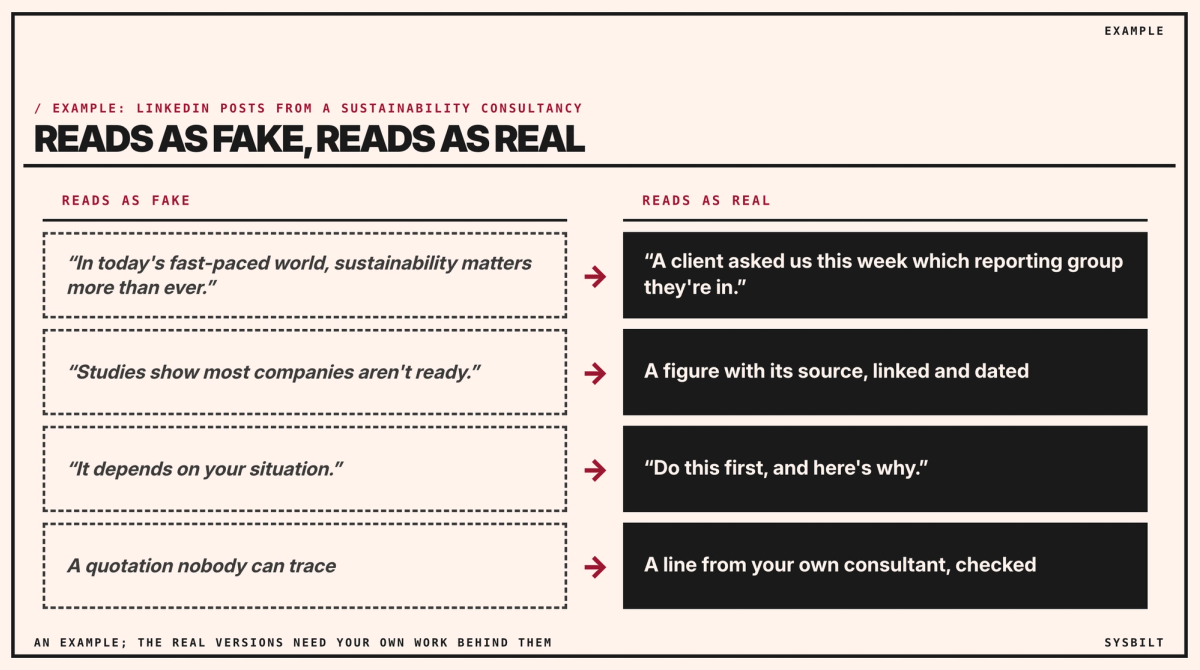
- Openings any business could write: "In today's fast-paced world…"
- Claims with no source: "Studies show…"
- No example from your own work, so nothing proves you've done it.
- No point of view. Everything is "it depends".
- Invented details: a figure, a client or a quotation that doesn't exist. AI tools can produce these confidently, and they're the one mistake that costs more than a scroll past.
Where AI fits
- 01Start from real material: a client's question, a call transcript, a voice note from the consultant who knows the subject.
- 02Let AI draft, with a prompt that keeps it honest: "Draft a LinkedIn post from this transcript. Use only facts in the transcript. Mark any claim that needs a source with [SOURCE?]. Don't add examples, figures or quotations that aren't in it."
- 03The expert edits: the consultant who knows the subject adds the example and the opinion, and cuts the lines anyone could have written.
- 04A second, senior person checks every fact, and opens the original for each one, such as the regulator's own page, not a summary of it. They log each figure, date and rule, the link to where it came from, and who checked it. Share the job between your senior consultants, so it doesn't wait on one person.
- 05Publish under the name of the person who knows it, on their own LinkedIn, then share it from the company page, so readers can see who stands behind it.
Should you say AI helped? Google's guidance suggests it where AI substantially wrote the content, asking whether that's "self-evident to visitors through disclosures or in other ways" (Google). Here the expert's thinking and every fact are human, so a short line is enough, such as "Drafted with AI from a conversation with [name], who checked every fact." It answers the question before a reader asks it.
If a post depends on a rule that's changing, or a figure nobody can source, hold it until you can.
Take client names and details out of transcripts before they go into an AI tool. The privacy regulator's advice is not to put personal information, especially sensitive information, into publicly available AI tools (OAIC). Use a business plan whose terms say it won't train on your content, and ask where it processes what you paste in.
One paragraph, before and after
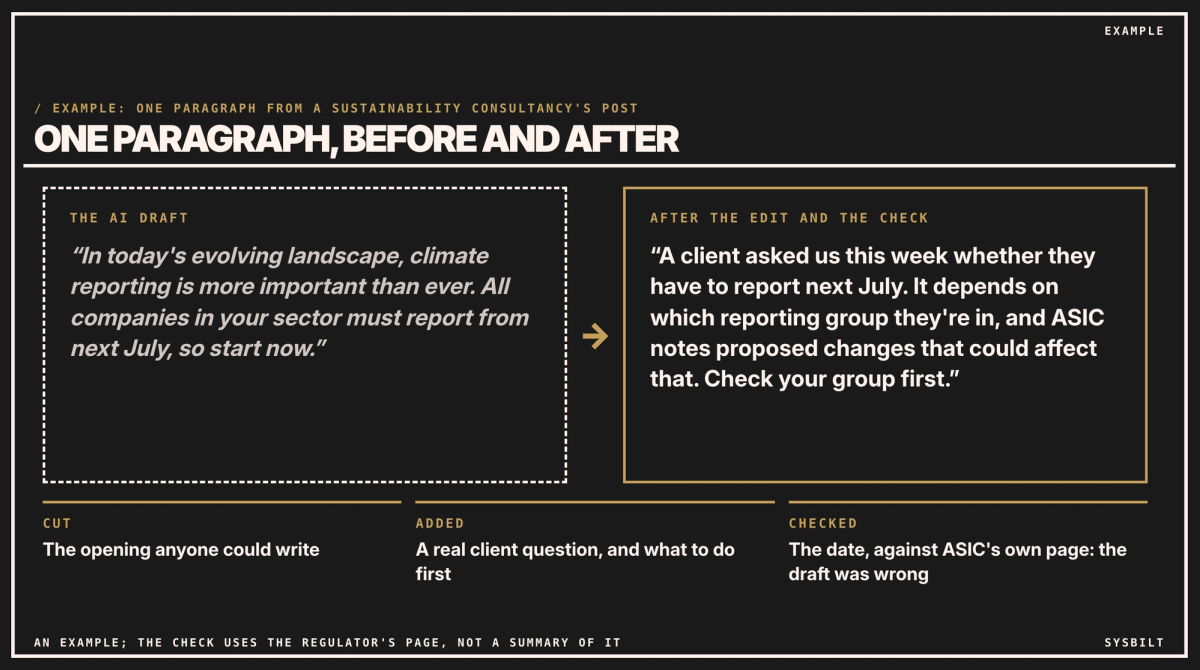
Here's how the steps catch the kind of mistake your team made last month. The AI draft said every company in a client's sector must report "from next July". The consultant cut the opening, added the client's real question and said what to do first. The checker opened ASIC's sustainability reporting page and found the blanket rule was wrong: when a company reports depends on which group it falls into, and ASIC notes proposed changes that could affect who has to report (ASIC). The post now says so, with the link.
The source log for that paragraph is one line in a shared sheet:
| Claim | Source | Checked | By |
|---|---|---|---|
| When a company reports depends on its group, and changes are proposed | ASIC, sustainability reporting page | 8 November 2026 | The second consultant |
Rules worth writing down
- AI never invents experience, clients, figures or quotations.
- Every figure has a source someone has opened. Under the Australian Consumer Law, businesses mustn't mislead customers (ACCC), and that includes what an AI tool wrote for you. Sustainability claims get extra attention, because ASIC acts on greenwashing (ASIC), so a post about climate reporting gets the same check as a client's report.
- Keep a list of phrases you never use, and add to it every time a draft sounds like everyone else. Start with "in today's fast-paced world", "more important than ever", "unlock", "game-changer", "navigate the complexities" and "it's important to note".
- One point of view per post. If the post doesn't say what you'd do, it isn't finished.
- Read it aloud. If you wouldn't say it to a client across the table, cut it.
Our post on a B2B content strategy for service businesses covers what to write about, and our post on repurposing one video into a month of content covers how to turn one piece into several.
If you'd rather have it set up, we build the way of working with your team: prompts built from your own material, the edit and the checks, so AI saves time without sounding like everyone else. That's part of our Content Systems service.
If you'd like a second pair of eyes, book a 15-minute call with our team in Sydney, by phone or video. Bring two posts your team drafted with AI, and we'll show you what reads as fake and how to fix it, so you leave with a checklist for the next one. There's no obligation after the call, and we don't upsell.
See how we fix this
See the exact system we build to fix this
Show me how to build an AI-assisted content system that still sounds like us
WRITTEN BY
Felipe Chaparro
Systems Architect and Founder of SYSBILT. Felipe engineers custom automation, AI workflows, and performance web architectures for scaling Australian service businesses.