How to systemise a business to sell or franchise it: what buyers and franchisees check, the operations manual, the numbers by site, and a month without you.
In this article
You run two sites, 22 staff and a waiting list on Saturdays. Clients ask whether you'd ever franchise, and a competitor has hinted they'd buy. Either way, the question is the same: would the business hold its value without you in it?
Here's how to systemise a business to sell or franchise it: what a buyer and a franchisee each check, the operations manual that makes it repeatable, the numbers by site, and a month at one site without you. If you'd rather step back from the day to day and keep the business, our post on building a business that runs without you is under Related articles at the end of this page.
The short answer
To sell or franchise, a business has to run the same way without its owner. Write the operations manual one process at a time, train from it, keep the numbers by site, and test it with a month at one site without you. Buyers pay less for a business that depends on one person, and franchising adds legal steps.
What a buyer and a franchisee check
Both are asking whether the business works without you, in different ways.
- A buyer asks whether the earnings will last once you leave. Buyers pay less for a business that depends on one person: William Buck, an accounting firm that sells valuation and succession advice, says key person discounts typically range between 10% and 25% of the value, depending on the business (William Buck, January 2025). They'll also want your records: financial statements for the last five years if possible, leases and insurance policies, and they may value the business themselves (business.gov.au).
- A franchisee asks whether they can run your business from your manual, in another town.
Franchising also adds legal steps before anyone signs (ACCC):
- 01Publish a profile on the ACCC's franchise disclosure register.
- 02Give an information statement within 7 days of someone formally applying or expressing interest in buying a franchise from you, before any other document.
- 03Give the franchise agreement, a disclosure document and a copy of the Franchising Code.
- 04Wait 14 days after the final documents before signing.
A franchising lawyer can prepare these with you, so talk to one before you offer a franchise. Each site needs its own registration, too: in Victoria, a business that boards dogs, by the day or overnight, must register with its council as a domestic animal business and follow the mandatory Code of Practice for the Operation of Boarding Establishments (Agriculture Victoria). Other states have their own rules, so check each new site's council and state, and its insurance. Before a buyer or franchisee sees your manual, ask your lawyer for a confidentiality agreement.
If you haven't decided between selling, franchising or keeping it, systemise first. The same work serves all three: get how the business runs out of your head and into something another person can follow.
Write the operations manual one process at a time
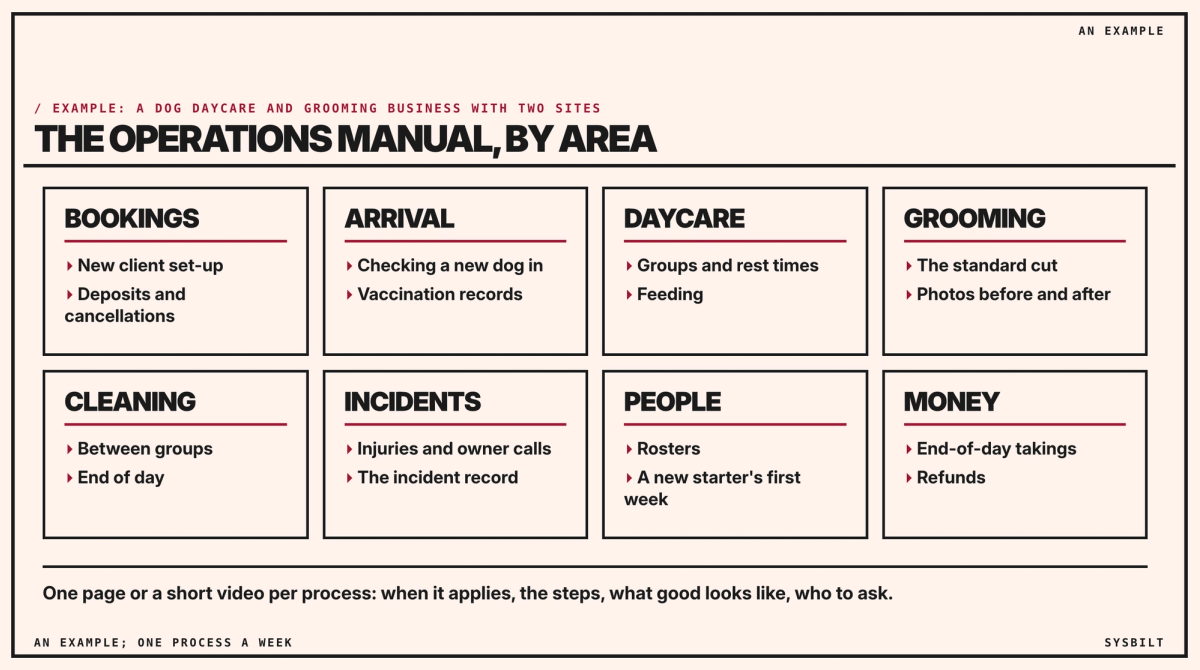
Start with the processes that make the business yours: checking a new dog in, including its vaccination record; the daycare groups; the grooming standard; cleaning between groups; what to do after an incident; bookings and payments.
Write one process a week, as a page or a short video: when it applies, the steps, what good looks like, and who to ask. Write each with the people who do the work, such as your head groomer for the grooming pages, and give them time off the floor to do it. For example, a page on checking a new dog in covers when it applies (a dog's first visit), the steps (the vaccination record sighted and saved, the owner's emergency contact, a meet-and-greet before the dog joins a group), what good looks like (the record is complete first) and who to ask (the site manager). Our post on documenting processes your team will actually read covers the format.
If a sale or franchise could come sooner, start with the ten pages a buyer or franchisee would ask about first: new client set-up, deposits and cancellations, checking a new dog in, vaccination records, groups and rest times, the standard cut, cleaning between groups, injuries and owner calls, the incident record, and end-of-day takings. At one a week, that's ten weeks.
Budget for it, too (an example): if each page takes two hours of the writer's time off the floor and an hour of yours to check it, ten pages take 20 hours of rostered cover and 10 of your hours over the ten weeks. Those 20 hours at the writers' hourly rates are the cost of the first ten pages.
Train from the manual, not from you
The manual only counts if people learn from it. A new starter works through the pages for their role, and the site manager signs off each task once it's done to the standard. Our post on the fastest way to train new staff covers the first shifts.
When a page is wrong or out of date, the person who spots it fixes it, or tells the site manager. That's what keeps a manual alive after you've stopped writing it.
Keep the numbers by site
A buyer or franchisee will want to see what one site earns on its own. Each month, keep each site's takings, wages, bookings against places, and how many clients came back: bookings and returning clients come from your booking software, and takings and wages from your accounts. Two sites whose numbers look alike show the model works more than once. Our guide to KPIs, dashboards and real numbers, under Related articles at the end of this page, covers how to set them up.
Test it with a month at one site without you
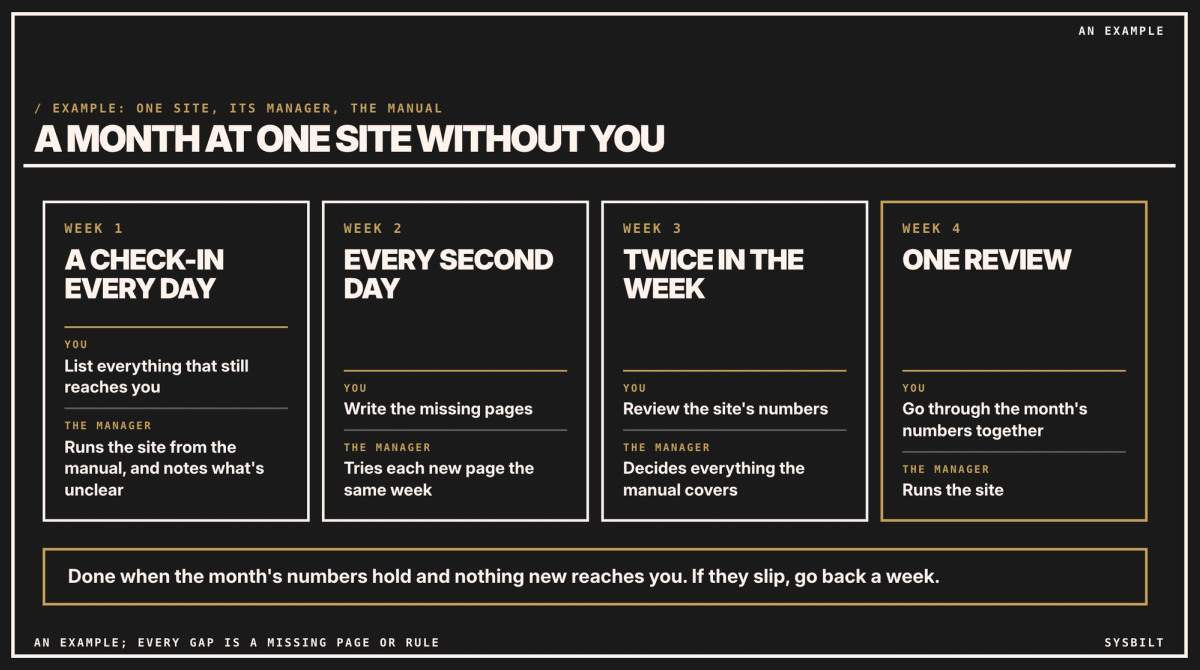
Before you start, check the manager is ready: they've run a full day from the manual, they've practised the incident page and know who to call in an emergency, and you've talked through what the month means for their role and pay. If you usually work shifts at that site, roster someone into them for the month and count those wages as part of the cost. Then hand the site to the manager. Check in every day in week 1, every second day in week 2, twice in week 3, and once in week 4. Anything that still reaches you goes on a list, and each item gets its own page in the manual before the month ends. If the numbers slip, go back a week and fix the pages that failed.
If you'd rather have help, we build the manual and the training with your team, one process at a time. That's our Team Training service.
If you'd like a second pair of eyes, book a 15-minute call with our team in Sydney, by phone or video. Bring a list of the ten things only you know how to do, and we'll pick the first five pages with you, so you leave with a plan for the manual. There's no obligation after the call, and we don't upsell.

WRITTEN BY
Felipe Chaparro
Systems Architect and Founder of SYSBILT. Felipe engineers custom automation, AI workflows, and performance web architectures for scaling Australian service businesses.