
What happens if your best employee quits tomorrow: what breaks, how to find what only one person knows, and how to capture it while they're still here.
In this article
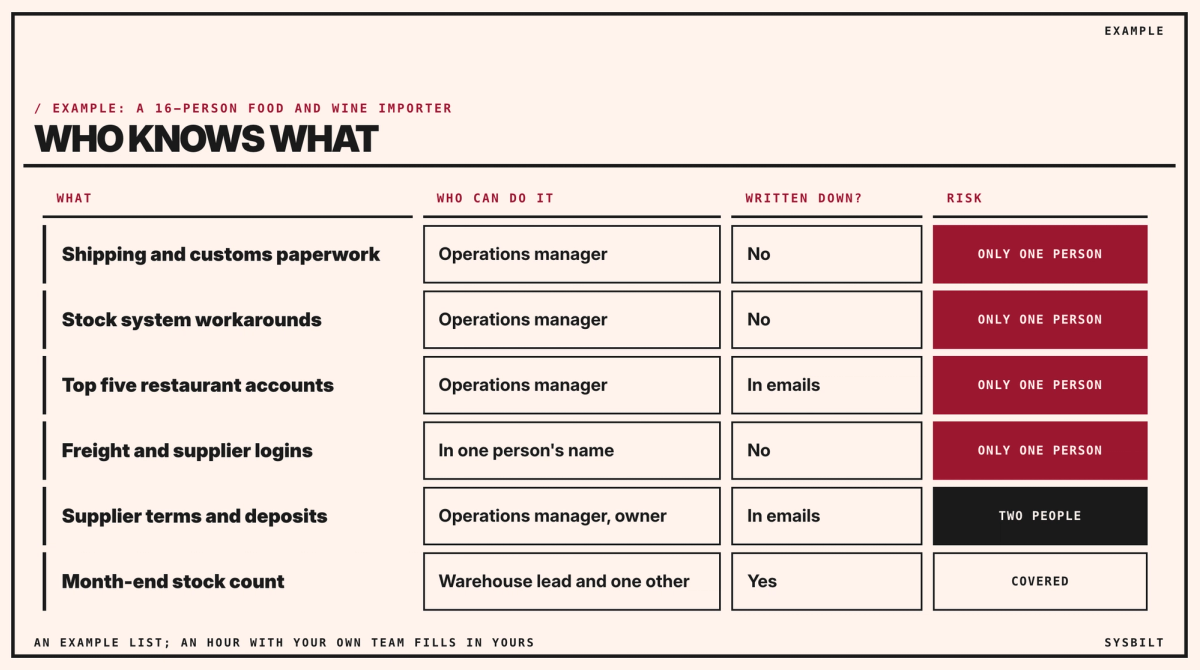
Your operations manager has been with you eleven years. They handle the shipping and customs paperwork, know every workaround in the stock system, and look after your five biggest restaurant accounts. Almost none of it is written down.
Here's what happens if your best employee quits tomorrow, how to find where the business depends on one person, and how to capture what they know while they're still here.
The short answer
Most of the damage comes from what was never written down or handed over. List what only one person knows, record the riskiest task first while they're still here, have a second person do it, introduce a second contact to your biggest clients, and move every login into the business's name.
It happens even in a quiet market
Just over 1.0 million employed Australians, 7.2%, changed their employer or business in the year to February 2026, down from 7.7% the year before (ABS). At that rate, a business with 15 employees sees about one of them change employer each year. Nobody can say which one, so plan as if it's the one you'd miss most.
What happens in the first month
- The handover is a rushed list. A few weeks' notice isn't enough to pass on eleven years, and most of it is in their head.
- Questions nobody can answer. Which supplier needs a deposit before shipping, how the customs paperwork goes to your broker, what to do when the stock system counts a pallet twice.
- Accounts nobody can open. Freight bookings, supplier portals and software in their name, with the security codes on their phone.
- Clients notice. Your biggest restaurant accounts have their mobile number, not the office's.
If you ever plan to sell, it matters again. Buyers pay less for a business that depends on one person: William Buck, an accounting firm that sells valuation and succession advice, says key person discounts typically range between 10% and 25% of the value, depending on the business (William Buck, January 2025).
Find what only one person knows
Take an hour with your team and list every task, client and login that matters. For each one, write who can do it and whether it's written down anywhere. Then mark the ones where only one person can. That's your list, in order of what would hurt most if it stopped next week.
Tell them why first
If your best person hears about this second-hand, it sounds like you're getting ready to replace them. So tell them first, and say what's in it for them: holidays without the phone ringing, fewer questions every day, and less resting on their shoulders. Ask them to lead it and choose the order, and count the time it takes as part of their role, in their next review too. You might start with: "You carry more of this business than anyone. I want you to be able to take a holiday without the phone ringing, so let's get what you know written down, and you choose where we start."
Capture it while they're here
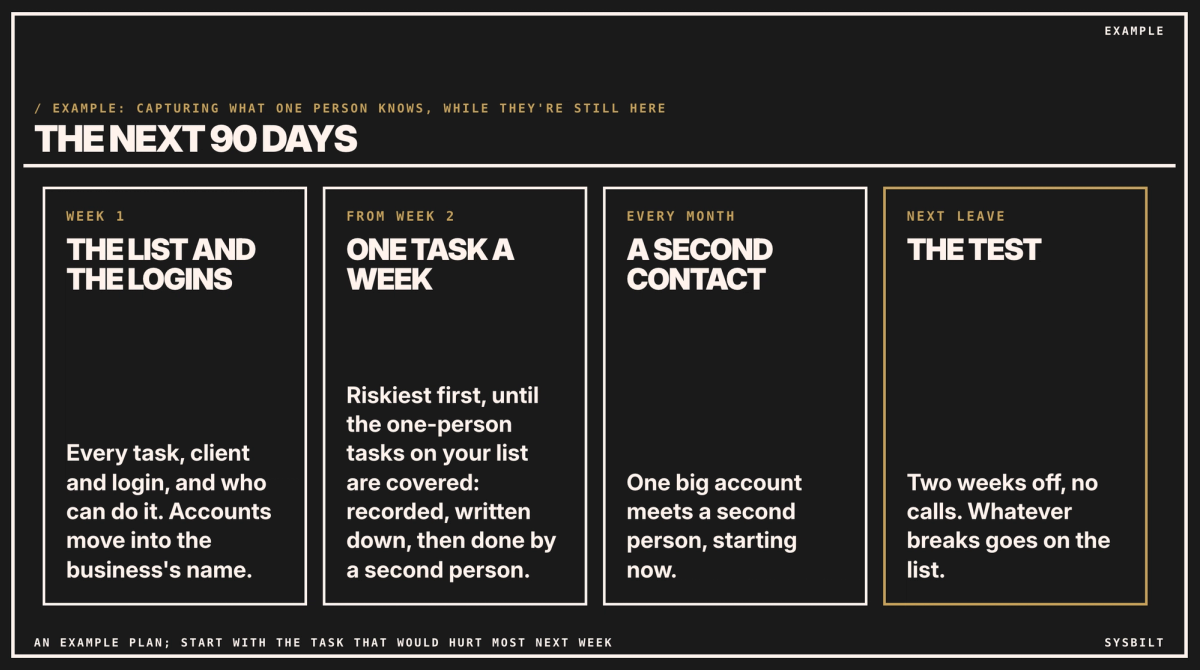
- 01Start with the riskiest task, the one that would hurt most if nobody could do it next week.
- 02They do it, and someone records it, on a phone or as a screen recording, with them talking through why, not only what.
- 03Write the steps underneath, with the exceptions: what goes wrong, and what to do then.
- 04A second person does it next time, using the recording, while the first person watches and corrects. Pick someone who already works next to the task, such as your warehouse lead for the stock system, and make it part of their role.
- 05One task a week, so it fits around normal work, until the tasks only one person can do are covered: for most businesses that's a handful, not twelve. Keep the recordings with your procedures, in the business's own storage, not on anyone's phone.
If a task legally sits with a licensed person, such as a customs broker lodging your paperwork, the recording doesn't change that. It shows your second person what to send, to whom and when. Each month, the list should show fewer tasks that only one person can do.
Our post on documenting processes your team will actually read covers how to write each one so it gets used. If your team asks them the same questions every day, our post on how to stop your staff answering the same questions covers how to write those answers down too.
Clients and logins
- Every account in the business's name, this week: freight bookings, supplier portals, banking and software. Keep the logins in a password manager the business controls, with security codes that don't depend on one person's phone.
- A second contact for your biggest accounts, one a month, starting now rather than in a notice period. Bring someone else to the next call or tasting and copy them in, so the client knows two people. If a customs broker lodges your paperwork, ask for a second contact on their side too, and copy your second person in.
Use leave as the test
When your best person next takes two weeks off, in a quieter month rather than your busiest shipping season, agree with them first: no calls unless something's on fire. Whatever breaks while they're away goes to the top of the list. It's the safest way to find the gaps, because they're coming back.
If they've already resigned
Use the notice period for the top of the list only. In the first week, move the logins and introduce the next contact to each big client. Then record the three riskiest tasks, and have the second person do each one while the leaver is still there to correct them. Everything else can be written up after.
None of this is about expecting them to leave. It's what lets them take a holiday without the phone ringing, and it takes some of the weight they carry for everyone else.
If you'd rather have help, we capture it with your team: the list, the recordings, the written steps and the handover, so what your people know stays in the business. That's part of our Team Training service.
If you'd like a second pair of eyes, book a 15-minute call with our team in Sydney, by phone or video. Bring the list of what only one person in your business knows, and we'll help you pick the first three to capture and how, so you leave with a plan for the next 90 days. There's no obligation after the call, and we don't upsell.

WRITTEN BY
Felipe Chaparro
Systems Architect and Founder of SYSBILT. Felipe engineers custom automation, AI workflows, and performance web architectures for scaling Australian service businesses.