How to build a business that runs without you: log what lands on you, hand decisions over with rules, write down what you know, and test it with a week away.
In this article
You own both stores and you're the senior optometrist, so every question finds you. Between patients, the front desk asks whether to refund a pair of frames, a supplier rings about a late order, and the other store wants to swap a shift. You haven't had a week off since the second store opened.
Here's how to build a business that runs without you day to day, or close to it: find what only you can do, hand over the rest with clear rules, write down what's in your head, and test it with a week away. Getting ready to sell or franchise instead? Our post on systemising a business to sell or franchise it is under Related articles at the end of this page.
The short answer
A business runs without you when decisions, know-how and numbers stop living with the owner. Log what lands on you for two weeks, write a rule for each decision you can hand over, with a person and a limit, write down what only you know, then test it with a week away and one short check-in a day.
Log what lands on you for two weeks
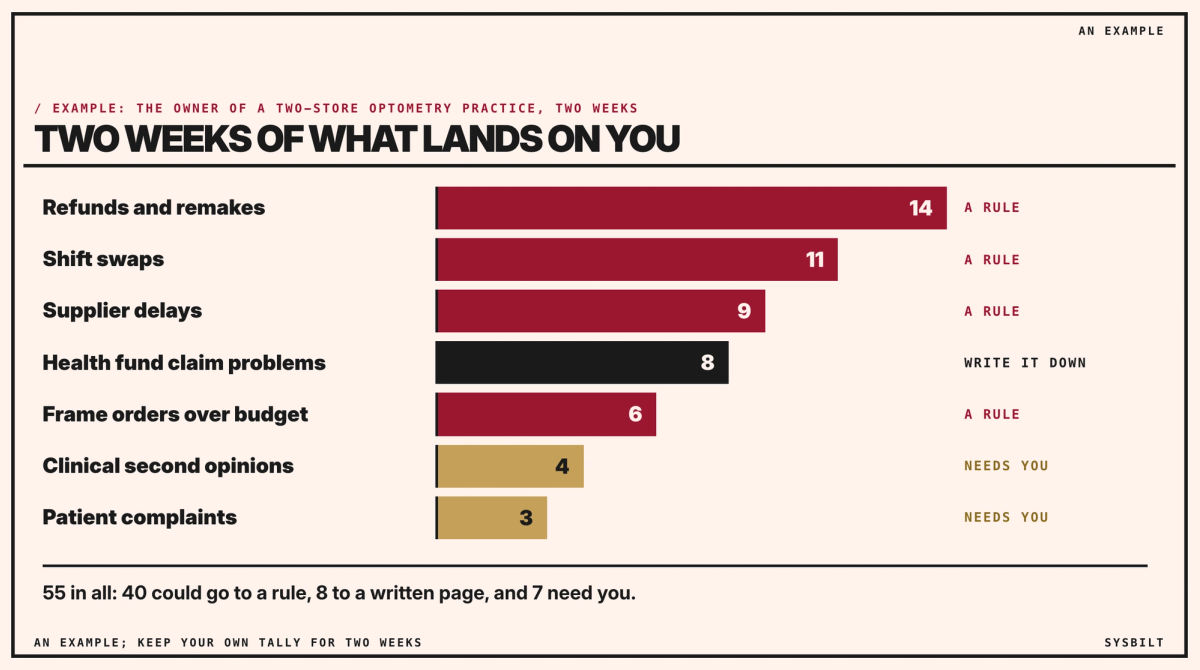
Keep a tally of every question, approval and exception that comes to you, in a notebook or a note on your phone. At the end of the fortnight, sort each one three ways:
- A decision someone else could make with a clear rule: refunds, supplier delays, shift swaps.
- Know-how only you hold: steps that are the same every time once someone knows them, such as fixing a health fund claim that bounces, or which supplier to ring when.
- What really needs you: clinical calls, which stay with the optometrists as the registered practitioners (the Optometry Board of Australia registers them and sets their standards), a complaint that's gone wrong, spending over a set amount, and hiring.
If your log looks like the example below, the first group is the biggest, and it's the part to hand over first. If two weeks feels long, start with the three things that came to you most this week.
Hand over decisions with a rule, a person and a limit
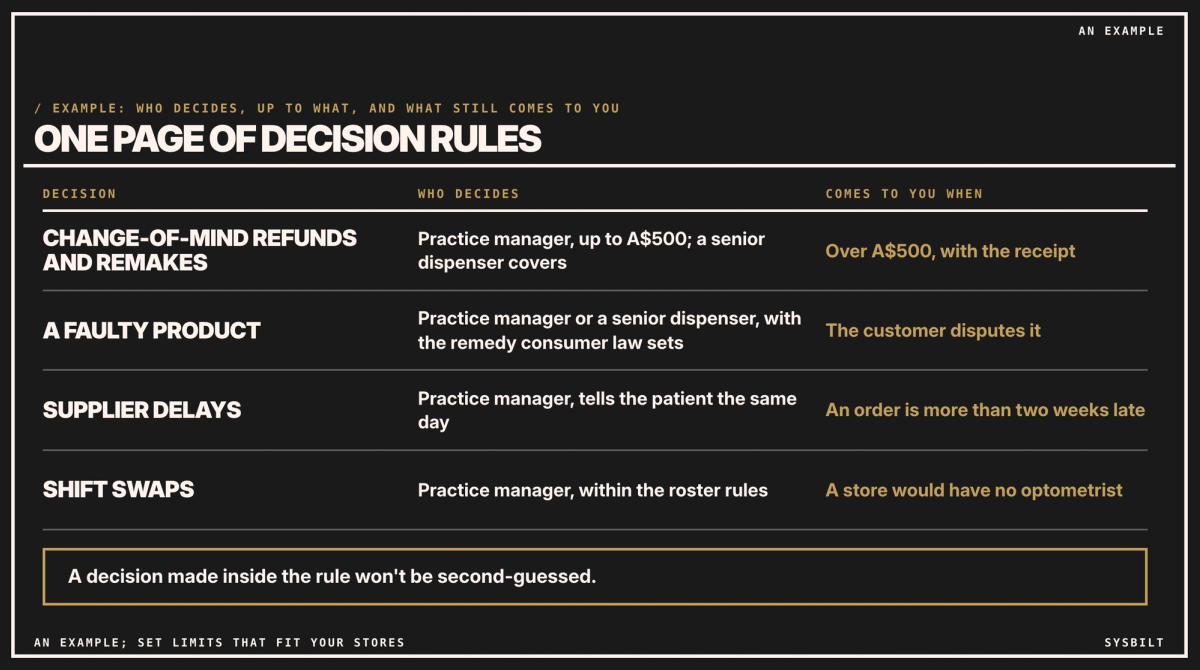
A rule says who decides, up to what limit, and what still comes to you. Write them on one page, give it to your practice manager to review first, and agree that anything a rule doesn't fit comes to you. If you don't have a practice manager, the rules go to your most senior non-clinical person, or that's the role to create first. Then tell the team that a decision made inside the rule won't be second-guessed. That's what stops them asking.
- Change-of-mind refunds and remakes: the practice manager decides up to A$500, and the senior dispenser at each store covers when they're away; above that, it comes to you with the receipt.
- A faulty product: the practice manager or a senior dispenser confirms the fault and offers the remedy, because consumer law already decides it, and it comes to you only if the customer disputes it. If a product or service doesn't meet the consumer guarantees, the customer is entitled to a repair, replacement or refund, and if you have a change-of-mind policy you must follow it (ACCC).
- Supplier delays: the practice manager tells the patient the same day and books the next fitting; it comes to you only if an order is more than two weeks late.
- Shift swaps: staff swap within the roster rules and the practice manager approves; it comes to you only if a store would be left without an optometrist.
The same pattern covers the rest of the log, such as frame orders over a patient's budget. The amounts and times here are examples, so set your own. Put the refund limit above the price of a typical pair at your stores, or most refunds will still come to you; start the other limits lower than feels comfortable, and raise them once the rules work.
Four kinds of decision now sit mainly with one person, so name who covers each rule when the practice manager is away, as the refund rule does. Our post on what happens if your best employee quits, under Related articles at the end of this page, covers that risk. Handing over decisions also changes your practice manager's role, so before you start, talk through what it means for their role and pay.
Write down what only you know
The know-how group is the slowest to hand over, because it lives in your head. Pick the item that came up most in your log and write it as one page: a title that says when to use it, the steps in order, a screenshot where the screen is confusing, and who to ask when the steps don't work. Then watch someone use it once. Our post on documenting processes your team will actually read covers the format.
If a page involves patient details, as a health fund claim does, say who may see them and where they're kept. A health service is covered by the Privacy Act whatever its turnover (OAIC).
Put the numbers where the team can see them
A team can't make your decisions if only you can see how the week is going. Pick three to five numbers, such as next week's bookings, orders waiting, refunds this week and cash in, and put them on one page the managers check every Monday. Bookings and orders come from your practice software and cash from your accounts. A simple automation can copy them across each Monday morning. If it's done by hand, put the steps on one page so whoever opens on Monday can do it, or the numbers depend on one person again. Our post on what a growing business should track weekly covers which ones.
Test it with a week away
Before you go, share the rules page, name who covers what, and agree what counts as an emergency. Roster an optometrist at each store, so clinical questions go to them, not to a rule. Your own appointments are the part of the week that costs money: book a locum optometrist at their day rate, or move your patients to the other optometrists and see fewer that week. Price both before you pick the week, and pick a quieter one. Keep one check-in a day, at a set time, for 15 minutes.
When you're back, go through what reached you anyway and ask of each one which rule didn't fit, or which page was missing. Fix the rule rather than blame the person. Once a week away brings you nothing outside the daily check-in, try two weeks; until then, fix what reached you and repeat the week.
If you'd rather have help, we run the two-week log with you and set up the rules page, the written steps and the weekly numbers in the tools you already use, such as your practice software, shared drive and accounts. That's part of our Automation service.
If you'd like a second pair of eyes, book a 15-minute call with our team in Sydney, by phone or video. Bring your two-week log, or a rough list of what lands on you, and we'll pick the first three rules with you, so you leave with a draft rules page. There's no obligation after the call, and we don't upsell.

WRITTEN BY
Felipe Chaparro
Systems Architect and Founder of SYSBILT. Felipe engineers custom automation, AI workflows, and performance web architectures for scaling Australian service businesses.