The fastest way to train new staff in Australia: paperwork before day one, a short video per task, three planned shifts with a buddy, and a manager's sign-off.
In this article
A new front desk person starts on Monday. Your studio manager trains them between classes, a bit at a time, and three weeks later they still can't open the studio alone. Across five studios, that happens most fortnights.
Here's the fastest way to train new staff in an Australian service business like yours: send the paperwork before the first shift, split the role into tasks, record each task once, and plan the first three shifts so a buddy teaches and a manager signs off.
The short answer
Train in the order the work happens, not all at once. Send the paperwork before day one, record each front desk task once as a short video with a checklist, then plan three shifts: watch, do it with a buddy, do it alone. A manager signs off each task, and the gaps you find go into the videos.
Before the first shift
Get the paperwork out of the way, so the first shift is spent learning.
- The Fair Work Information Statement, and the Casual Employment Information Statement for anyone casual. Employers must give these before, or as soon as possible after, someone starts (Fair Work Ombudsman).
- The forms payroll needs and the logins for the booking software, sent with a welcome email.
- The first three shifts on the roster, each with the same buddy: an experienced front desk person who'll teach them, ideally on quieter shifts.
Split the role into tasks
Write down what the role does on a shift, one task per line. For the front desk: checking clients in, bookings and cancellations, memberships and class packs, payments and refunds, and opening and closing the studio.
Then pick the ones a new person needs first. Here that's four: checking clients in, bookings and cancellations, memberships and class packs, and payments and refunds. Refunds come with a limit until they're signed off: a new person refunds up to one class pass, say, and anything more waits for the manager, because a refund can't be taken back. Opening and closing come after those. Safety comes before all of them. Under work health and safety laws, a business must give workers the information, training, instruction and supervision they need to work safely (Safe Work Australia). For a studio, that's the exits, the first aid kit, how to report an incident and who to call, on the first shift.
Record each task once
- A two- or three-minute video for each task, made by the person who does it best: on a phone at the desk, or as a screen recording of the booking software. Record with a test client, not a real one, so no client's details end up in a video.
- A checklist under each video with the steps, and the words to use where they matter, such as what to say when a client arrives after class has started.
- One set for all five studios, so every studio trains the same way and a starter can work at any of them.
- One place for all of them, next to your procedures, so a new person can find a task again in their second week.
- A new recording when the task changes, such as a new booking system or a new membership. The old one moves to an archive folder that only the owner opens, so nobody learns the wrong way and you can still show what the instruction said on a given date.
Our post on documenting processes your team will actually read covers how to write each checklist.
Plan the first three shifts
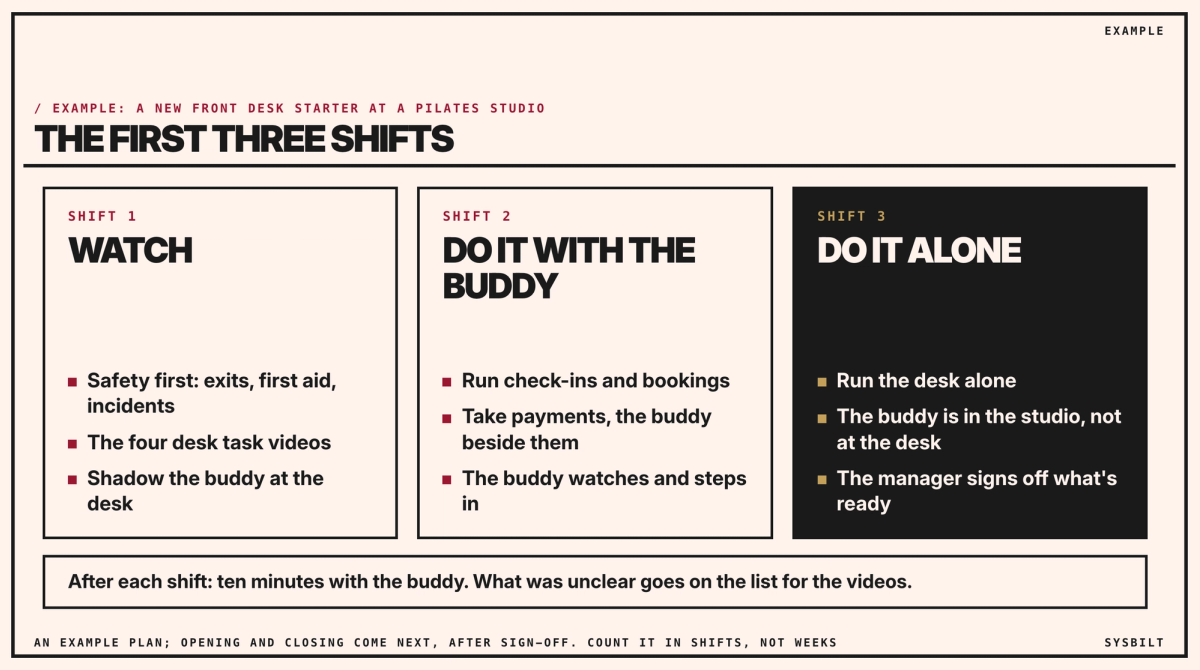
- 01Shift 1: watch. Safety first, then the four task videos, then shadow the buddy at the desk.
- 02Shift 2: do it with the buddy. The new person runs check-ins, bookings and payments, and the buddy watches and steps in.
- 03Shift 3: do it alone. The buddy stays in the studio but not at the desk.
The buddy doesn't need to be the studio manager. An experienced front desk person is better, because it's their work every day, and it takes the load off the manager.
After each shift, take ten minutes with the buddy, rostered as part of the shift: what was unclear? Each answer goes on a list, and the list is how the videos get better for the next person. For a casual or part-timer, the three shifts may fall across one or two weeks; keep the same buddy, because the order matters more than the dates.
Opening and closing come next: twice with the buddy, then alone once the manager signs off. Count it in shifts, not weeks: in this example, a new starter runs the desk alone after their third shift and opens a studio after about six. For a casual on two or three shifts a week, that's the desk alone within a fortnight and opening by the third week, against three weeks and still not alone the old way. It's faster because the new person no longer waits for a manager's spare minutes between classes: the videos teach, the buddy shows, and the roster sets the pace.
Sign off each task
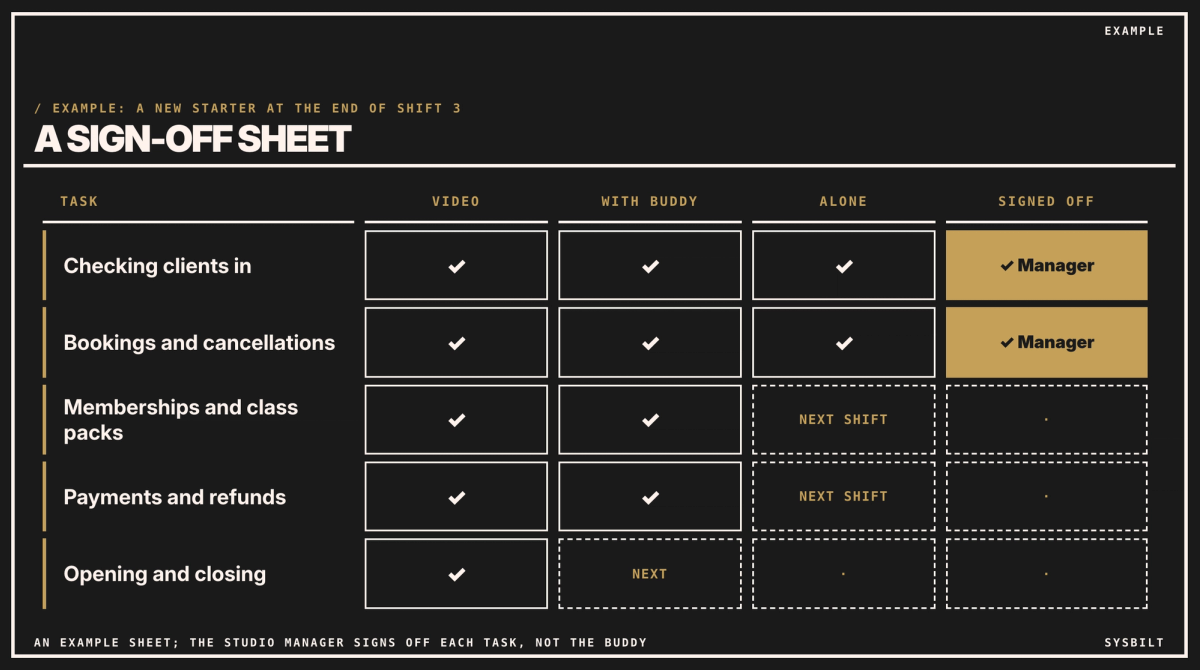
Keep one sheet for each new starter, with a line for each task and four columns: video watched, done with the buddy, done alone, and signed off. The studio manager signs off, not the buddy, and only a manager's signature lets someone open or close a studio alone. Signing off means the manager watches the task done once, start to finish, on a normal shift, and signs if it's right. It's one signature per task, and it replaces the guess about what a new person can do.
A task that isn't signed off by shift 3 isn't a failure. It goes on the next shift's roster with the buddy, and the sheet shows everyone where the new person is up to.
Check at 30 days
A month in, sit down for fifteen minutes. Ask what was hard, what was missing and what they'd tell the next starter, and add what was missing to the videos and checklists. Then compare how many shifts each task took to sign off with the last starter. That's how you know the training is getting faster. And if a starter learns the booking software but works around it, our post on why teams refuse to use new software, under Related articles at the end of this page, covers that.
Our post on the best software for writing standard operating procedures covers where to keep the videos and checklists.
If you'd rather have it set up, we build it with you: the task list, the videos, the checklists and the sign-off sheet, in the tools your team already uses. That's part of our Team Training service.
If you'd like a second pair of eyes, book a 15-minute call with our team in Sydney, by phone or video. Bring the list of what a new front desk person has to learn, and we'll help you split it into tasks and plan the first three shifts, so you leave knowing what to record first. There's no obligation after the call, and we don't upsell.
See how we fix this
See the exact system we build to fix this
Show me how to build a training system for my team
WRITTEN BY
Felipe Chaparro
Systems Architect and Founder of SYSBILT. Felipe engineers custom automation, AI workflows, and performance web architectures for scaling Australian service businesses.